When Manual Pentesting Isn't Enough: Why Mature SaaS and Fintech Teams Add Secure Code Review
Discover why mature SaaS and fintech teams complement manual penetration testing with secure code review. Learn how source-level analysis uncovers hidden vulnerabilities, identifies recurring security weaknesses, and helps engineering teams address root causes, especially as applications grow more complex and AI-assisted development accelerates.
TL;DR
Penetration testing and secure code review answer different security questions.
- Manual penetration testing tests the deployed application from an attacker's perspective and validates what an attacker can actually exploit.
- Secure code review examines the underlying implementation, including security controls, business logic, data flows, and recurring coding patterns.
- Code review can uncover vulnerabilities that external testing may miss, such as hard-coded credentials and insecure implementation patterns.
- It can also reveal whether an individual vulnerability is part of a broader pattern, helping engineering teams fix classes of problems rather than individual instances.
- This becomes especially valuable as applications become more complex, teams adopt AI-assisted development, or organizations face additional secure-development and compliance requirements.
Why Isn't Penetration Testing Enough for a Mature Security Program?
If your company has been penetration testing its application for years, you probably understand what an attacker can do. You know which endpoints are exposed. You know whether authentication and authorization controls hold up under attack. You know where attackers can abuse business logic and whether they can chain vulnerabilities to reach sensitive data or functionality.
But there is another question a penetration test cannot fully answer:
How is security actually implemented inside the application?
That distinction becomes more important as a SaaS or fintech company matures. Applications accumulate APIs, integrations, business logic, authorization rules, third-party dependencies, and sensitive data flows. Engineering teams continue shipping new functionality while security teams continue testing the application from the outside. Increasingly, developers use AI to help write and modify that code. At some point, testing what an attacker can reach may not provide enough visibility into the code behind it.
That's where secure code review can complement penetration testing.
What Does Manual Penetration Testing Tell You?
A manual penetration test examines the application from an attacker's perspective.
The pentester interacts with the deployed system, looking for weaknesses in authentication, authorization, APIs, business logic, session management, exposed functionality, and other attack surfaces. A good manual pentest shows whether a weakness can be exploited and what an attacker could accomplish with it.
An authorization flaw isn't just a code-level weakness; its severity depends on what an attacker can do with it. For example, a flaw that allows an attacker to access another user's account is more serious than one that doesn't grant access to protected resources. Similarly, an information disclosure that appears low-risk on its own may become more serious if an attacker can combine it with another vulnerability to reach sensitive functionality.
Runtime testing provides visibility into those attack paths, and it can answer questions such as:
- Can an attacker bypass authentication?
- Can one user access another user's data?
- Can an attacker escalate privileges?
- Can multiple vulnerabilities be chained together?
- What happens when the application receives unexpected input?
- What sensitive information is exposed through responses or errors?
- What can an attacker ultimately reach?
This is the strength of penetration testing: it demonstrates what is actually possible against the running application.
For example, an XSS vulnerability can be identified through source-code analysis. Still, a penetration test can validate whether that vulnerability is actually exploitable in the deployed application and demonstrate its impact.
What Does Secure Code Review Add?
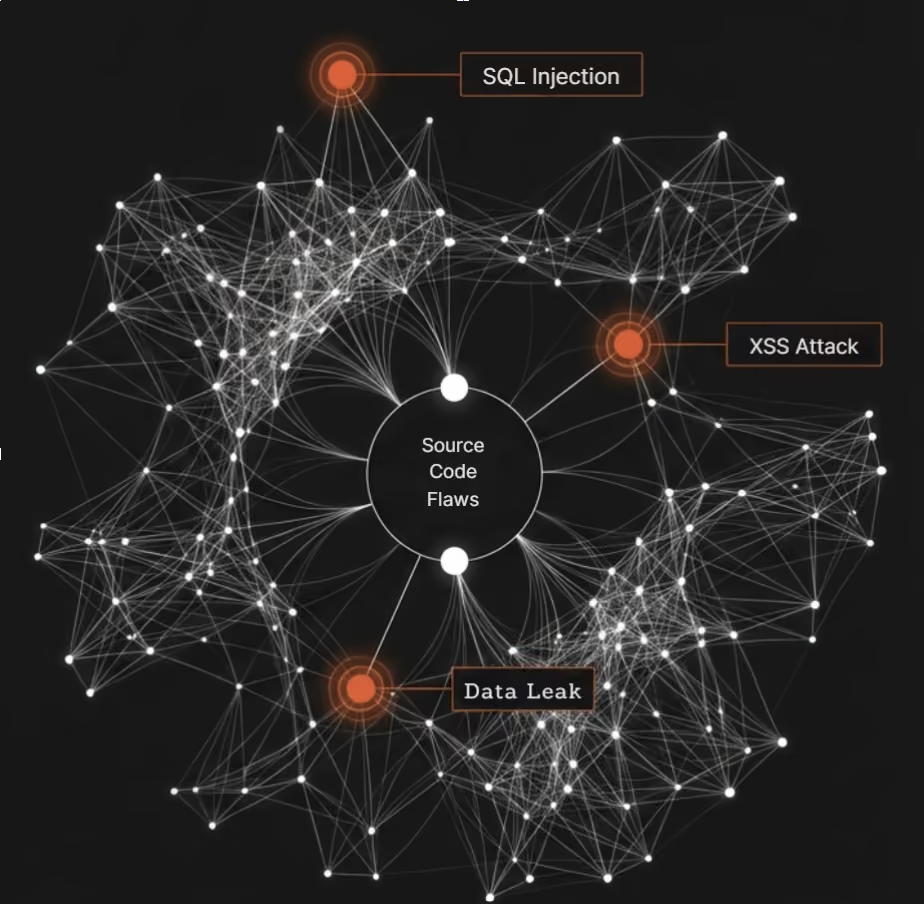
Secure code review complements manual penetration testing by providing visibility into the implementation itself. While penetration testing evaluates how an application behaves under real-world attack scenarios, code review lets reviewers examine how authentication, authorization, data handling, cryptography, business logic, and other security-sensitive functionality are implemented. Together, these approaches provide a more complete view of an application's security.
The biggest value isn't simply finding vulnerabilities a pentest missed, but moving from finding bug instances to understanding their causes.
Imagine a penetration test identifies an authorization vulnerability on one endpoint.
That's useful. The team can fix the endpoint.
But what if the underlying problem is that authorization is being checked independently across dozens of controllers rather than through a consistent authorization layer?
A code review can expose that broader pattern and let the reviewer find other instances of the same problem.
That changes the remediation conversation from:
"Fix this endpoint."
to:
"Why are authorization decisions being implemented this way throughout the application, and where else does the same problem exist?"
That's where source-level analysis can provide significant leverage.
Two perspectives on application security
Penetration testing better demonstrates exploitability and impact. Code review is better at understanding implementation and identifying systemic weaknesses that may not show up through the application's external attack surface.
What Does This Difference Look Like in Practice?
Here is a real example from the field:
A company conducted a secure code review focused on integrations in one part of its platform, along with a separate web penetration test covering its Marketplace application.
The scopes were different, so this isn't a controlled comparison of identical code. But the vulnerabilities illustrate how differently the two testing approaches can surface security risks.
The code review identified five unique vulnerabilities:
- Two instances of hard-coded credentials
- A path traversal vulnerability
- Two instances of hard-coded JWTs
The web penetration test identified a different set of issues, including:
- Cross-site scripting
- Improper restriction of excessive authentication attempts
- Firewall bypass
- Inadequate protection of an administrative interface
- Information exposure through error messages
The key point is that the vulnerabilities differed because the testing methods provided different visibility.
What the web pentest validated
The web pentest interacted with the live application and validated how it behaved under attack.
For example, the XSS vulnerability wasn't simply a theoretical observation that potentially unsafe code existed. The penetration test provided evidence that the vulnerability could be exercised against the running application.
The same applies to authentication rate limiting and other runtime behaviors. The pentester could send requests, manipulate inputs, observe responses, and determine what an attacker could actually accomplish.
That is exactly what a penetration test should do.
What the code review exposed
The code review, meanwhile, found credentials and JWTs embedded in the source code, along with a path traversal vulnerability. Those vulnerabilities illustrate a different type of visibility.
A credential embedded in source code doesn't need to be returned by a public endpoint to be a security problem. A hard-coded JWT doesn't need to appear in an HTTP response for a reviewer to identify it.
The reviewer can see the implementation directly.
That doesn't mean a pentest can't find these issues, or that code review can't identify XSS. It means the reviewer has access to a different layer of the application and can investigate problems that normal external testing may not expose.
Can Secure Code Review Find Patterns Behind Individual Vulnerabilities?
Yes. This is one of the most valuable reasons to perform a manual review.
A penetration test generally reports vulnerabilities the pentester identified and validated. A code review can go further by asking whether the implementation pattern behind a vulnerability appears elsewhere.
Consider authorization.
Suppose a penetration test identifies an insecure direct object reference on one endpoint. The immediate remediation is to fix that endpoint. But during a code review, the reviewer may discover that the application implements authorization checks independently throughout.
The individual vulnerability is no longer the whole story. The security team has discovered an implementation pattern that could produce an entire class of vulnerabilities.
The same principle applies to:
- Inconsistent authorization logic
- Repeated insecure input handling
- Unsafe trust boundaries
- Insecure cryptographic implementations
- Sensitive data flowing through unsafe paths
- Security controls applied in one workflow but omitted from another
- Repeated insecure coding patterns
The goal isn't to find fifteen versions of the same vulnerability just to increase the vulnerability count. The goal is to understand why the vulnerabilities exist and whether the underlying implementation can be improved.
Perusall provides a useful example of this approach. During a major platform rewrite, the engineering team used AI-assisted development to accelerate the transition to a modern architecture. Software Secured reviewed the resulting codebase, identified vulnerability patterns, and then used source-level analysis to uncover additional instances across the codebase.
The review wasn't simply about finding isolated bugs. It gave the engineering team visibility into where vulnerabilities existed, why they could cause problems, and how to prevent them in the future. That is the value of looking for patterns rather than treating every vulnerability as an isolated ticket.
What Does AI-Assisted Development Change About Secure Code Review?
AI-assisted development changes the scale and speed of code production. That creates an important security question:
What happens when an insecure implementation pattern is generated repeatedly across a codebase?
The concern isn't that AI-generated code is inherently insecure. The problem is that engineers can generate code quickly without understanding or challenging every security assumption.
The PCI Security Standards Council has also highlighted the distinction between functional code and secure code when AI is involved.
Perusall illustrates the challenge in a real development environment. Its engineering team was rewriting an extensive, ten-year-old system using AI-assisted workflows. The team reviewed the resulting codebase before production and identified and remediated critical risks before launch.
The interesting part isn't simply that they used AI. The speed of AI-assisted development made independent source-level validation even more valuable. If an AI-assisted workflow introduces the same insecure pattern into multiple parts of an application, finding one instance during a pentest may only address the symptom. A code review can identify the pattern and look for additional instances, making variant analysis particularly relevant to AI-assisted development.
The faster code is produced, the more important it is to understand whether the same security mistake has repeated throughout the codebase.
Is SAST the Same as Manual Secure Code Review?
No.
SAST tools are valuable because they can analyze large amounts of code continuously and identify recognizable insecure patterns. They can run as part of the development workflow and provide developers with fast feedback.
Manual review adds context.
A human reviewer can examine how a security control interacts with the application's architecture, business logic, authorization model, data flows, and trust boundaries. For example, an automated tool might flag a potentially unsafe function call. Still, a manual reviewer can investigate why the function is used, what data reaches it, whether the input is attacker-controlled, what security controls exist upstream, and whether the same implementation pattern appears throughout the application.
When Should You Add a Secure Code Review?
There isn't a single maturity threshold at which every organization needs a code review. But several situations strongly signal that it may be time to look deeper.
You've established recurring penetration testing
If your organization already conducts regular manual penetration tests across its network and applications, secure code review can add another layer of assurance by examining the underlying implementation, security controls, and business logic.
Your application has become materially more complex
More APIs, integrations, services, roles, workflows, and data stores create more interactions and more security assumptions. Complex authorization models and business logic matter because they can span multiple components and aren't always fully visible from the outside.
You're seeing recurring vulnerability classes
If penetration tests repeatedly uncover similar vulnerability categories, don't just keep fixing them individually. Ask why they keep happening.
Repeated authorization problems, input-handling issues, or insecure implementation patterns may indicate an underlying engineering problem that source-level review can help identify.
You're using more AI-assisted development
When AI generates or modifies large amounts of code, manual review can help determine whether insecure patterns repeat across the codebase.
You're making a major architectural change
A rewrite, new framework, cloud migration, expansion into microservices, or significant change to authentication and authorization can justify deeper review.
You're launching high-risk functionality
Authentication, payments, administrative functionality, sensitive data exports, new APIs, third-party integrations, complex approval workflows, and AI-driven functionality can all warrant deeper source-level scrutiny.
You're subject to secure-development requirements.
For fintech teams, compliance can also trigger scrutiny. PCI DSS Requirement 6.2.3 requires reviewing bespoke and custom software before release to identify and correct potential coding vulnerabilities. The requirement applies to both internal and public-facing custom software, and code reviews may be performed using manual processes, automated processes, or a combination of both. For organizations subject to PCI DSS, secure code review can therefore serve both a security and compliance purpose.
What Should a Good Secure Code Review Actually Tell You?
The value of a code review depends on what it examines and whether the results are useful to engineering.
At minimum, buyers should understand:
- What code is in scope? Entire codebase, specific services, or selected components?
- Are security-sensitive areas covered? Authentication, authorization, APIs, payments, administrative functionality, and other high-risk workflows?
- Are data flows and trust boundaries examined?
- Is business logic reviewed?
- Are vulnerabilities tied to the actual implementation?
- Does the reviewer look for repeated patterns?
- Can developers understand how to remediate the issues?
- Does the review complement, rather than duplicate, existing penetration testing?
A useful review should help engineering understand what went wrong, why it happened, and whether the same problem exists elsewhere.
How Do Penetration Testing and Code Review Work Together?
The simplest way to think about the difference is that they answer different questions.
Automated analysis identifies recognizable patterns at scale.
Manual secure code review examines implementation, architecture, business logic, and underlying security patterns.
Manual penetration testing validates exploitation and impact against the running application.
A mature security program can use all three.
The goal is to understand the application from more than one perspective and identify weaknesses deeply enough to address the underlying problem. If your team already has a strong penetration testing program, secure code review can provide the source-level visibility that external testing doesn't.
FAQ: Secure Code Review vs. Penetration Testing
Is secure code review better than penetration testing?
No. They test different aspects of application security.
Penetration testing validates how the deployed application behaves under attack and demonstrates what an attacker can exploit. Secure code review examines how security is implemented in the source code and can identify underlying implementation patterns that aren't necessarily visible externally.
If we've already pentested our application, do we still need a code review?
Potentially. A penetration test doesn't provide the same source-level visibility as a code review.
Code review becomes particularly useful when applications are complex, vulnerability patterns recur, AI-assisted development is increasing, major architectural changes are underway, or you need deeper secure-development evidence.
Can a code review find XSS?
Yes.
XSS can be identified through source-code analysis and runtime testing. A penetration test can validate whether the vulnerability is exploitable in the deployed application. At the same time, code review can examine the implementation that creates the vulnerability and look for the same pattern elsewhere.
Is SAST the same as secure code review?
No.
SAST provides scalable automated analysis for recognizable patterns. Manual secure code review adds human analysis of business logic, architecture, data flows, authorization, trust boundaries, and context.
Does secure code review replace a pentest?
No.
A code review cannot fully demonstrate what an attacker can accomplish against the deployed application. Penetration testing provides that attacker-and-runtime perspective.
For mature applications, the two methods complement each other.
Is secure code review required for PCI DSS?
PCI DSS Requirement 6.2.3 requires reviewing bespoke and custom software before release to identify and correct potential coding vulnerabilities. The requirement allows manual, automated, or combined reviews.
Organizations should evaluate the current PCI DSS requirements and their applicable validation path to determine exactly what applies to their environment.
Conclusion
For mature SaaS and fintech teams, the question isn't whether one approach is better.
It's whether your current security program gives you enough visibility to understand both what can be exploited and why those weaknesses exist in the first place.
If you've already established a strong penetration testing program and are ready to look deeper into your application's code, a secure code review can add another layer of visibility and assurance.
Explore Software Secured's Secure Code Review.