Top 10 FinTech Penetration Testing Providers (2026)
Fintech platforms operate in one of the most targeted and high-risk environments in modern software. This guide breaks down the top penetration testing providers for 2026, with a focus on how well they simulate real financial attack paths, test transaction logic, and support engineering teams.
The last 12 to 18 months have made one thing clear. Attackers are not targeting fintech platforms because they are easy. They are targeting them because they are valuable and predictable.
In early 2026, a DeFi platform lost roughly $40 million in cryptocurrency after attackers compromised executive devices and gained access to treasury controls. This was not the result of a missed patch or an outdated library. It was a combination of access-control breakdowns, key-management exposure, and operational gaps that allowed attackers to move money once inside.
Around the same time, a fintech provider serving banks and credit unions experienced a ransomware attack that exposed sensitive customer data, including financial information and Social Security Numbers. The entry point was a compromised infrastructure component. Once again, the failure was not a single vulnerability but a breakdown in how systems and dependencies were secured and monitored.
A growing share of global breaches now involves financial platforms, with losses frequently reaching into the millions per incident and billions lost to crypto-related exploits in recent years. These incidents are often tied to third-party integrations, identity weaknesses, and API-level trust failures rather than obvious technical flaws.
Across these cases, the failure point is consistent. Systems behave as expected under normal conditions, but break down when exposed to adversarial behavior. That gap between expected use and abuse is exactly where attackers operate.
Why Penetration Testing for FinTech Is Different
Financial platforms operate in one of the most adversarial environments in modern software. Payment rails, digital wallets, embedded finance APIs, crypto infrastructure, and banking integrations move money in real time. When something breaks, attackers do not wait. They automate exploitation and scale it quickly.
That reality changes what penetration testing for fintech needs to cover. The attack surface extends beyond typical web vulnerabilities into transaction flows, authentication layers, authorization logic, and third-party financial integrations. Many of the most damaging failures stem from logic flaws in how systems enforce trust, handle identity, or process financial transactions.
This is where many organizations get it wrong. Fintech security testing is often approached like a standard web application assessment. A vendor runs automated scans, probes a handful of endpoints, and produces a report centered on technical hygiene. Meanwhile, the real risk lies in transaction handling, account-linking flows, and fraud controls that were never exercised in realistic attack scenarios.
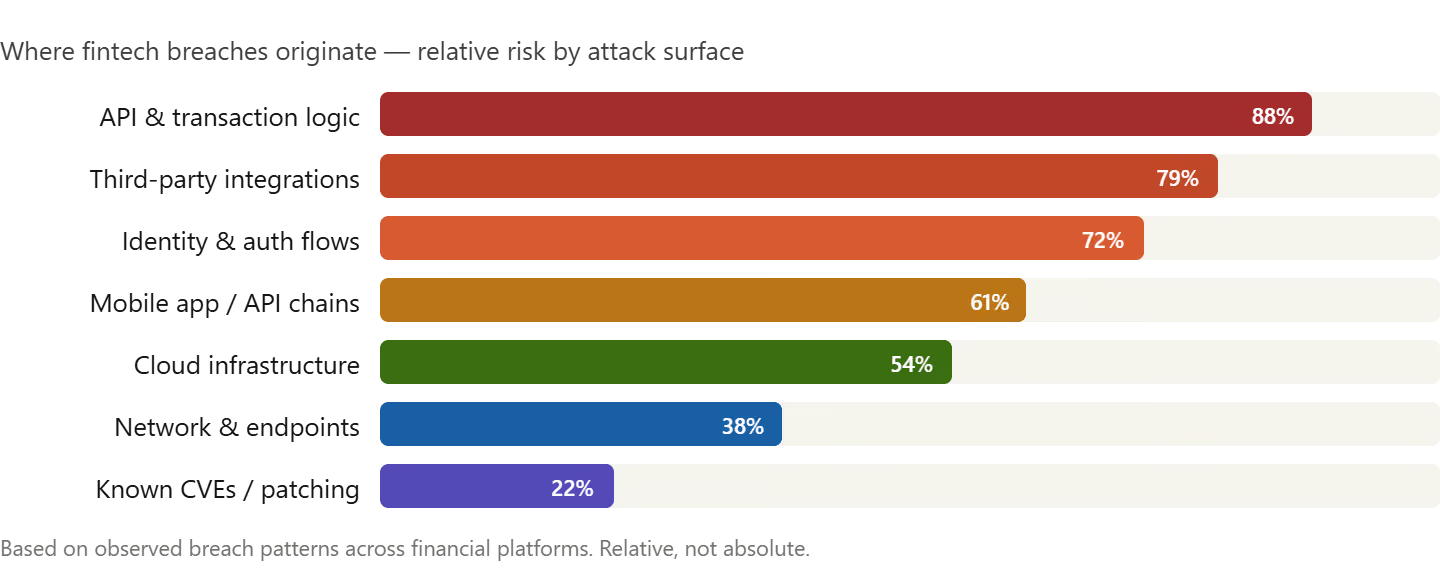
Effective penetration testing for the fintech industry focuses on how attackers actually extract value. That means simulating fraud scenarios, manipulating API requests, chaining authorization weaknesses, and testing how financial workflows behave when pushed outside normal conditions.
For IT and security leaders, the goal is not to confirm that controls exist. It is to verify that the systems responsible for moving and protecting money hold up under active testing of those controls.
What to Ask Before You Sign a Statement of Work
Security leaders evaluating vendors often struggle to distinguish genuine fintech specialists from firms that primarily test SaaS applications. A few screening questions can reveal a lot about how well a vendor understands the penetration testing needs of fintech companies.
Why Listen to Us
We have worked with hundreds of product teams operating in high-risk environments, including fintech platforms, digital wallets, trading systems, and SaaS companies that process payments.
That experience informs how we evaluate vendors in this guide. The following list highlights several of the best penetration testing companies for fintech, based on technical depth, methodology, and real-world experience working with financial platforms.
Top 10 FinTech Penetration Testing Providers (2026)
The following profiles are designed to help IT and security leaders evaluate pentest providers based on their technical capabilities, fintech-specific experience, delivery model, and fit for different organizational profiles. No two fintech platforms have the same risk profile, so the right vendor depends on your threat environment, development pace, compliance obligations, and budget.
1. Software Secured
Software Secured is a North American penetration testing firm focused on product security for software companies, with a strong track record in Fintech and SaaS. Their methodology is built around manual testing and engineering collaboration rather than automated scanning or compliance box-checking.
Fintech-Specific Strengths:
- Simulations target fraud and payment abuse scenarios, including rate limiting, business logic abuse, and manipulation of transaction states and payment workflows
- Manual application and API testing validate hidden authorization flaws, assess balance changes, refunds, and money movement logic, and confirm token handling limits and tenant isolation across multi-tenant financial platforms.
- Cloud and data environment validation ensures that the infrastructure supporting financial workloads is tested against real-world attack paths.
- Pentest reports are structured to satisfy compliance requirements and investor due diligence, including CVSS and DREAD scoring, fix guidance, and alignment to frameworks such as PCI DSS, SOC 2, and ISO 27001
- Offers Penetration Testing as a Service (PTaaS) for teams that need ongoing testing aligned with continuous deployment cycles
Delivery Model: Project-based or PTaaS subscription; annual, biannual, or quarterly cadence options available.
Best For: Fintech product teams at growth-stage to mid-market companies that move quickly and need testing depth combined with engineering-first reporting.
Pros:
- Strong manual methodology focused on financial attack paths
- Engineering-friendly reports that development teams can act on immediately
- Retesting is included to confirm that vulnerabilities are fully resolved
- Accessible and responsive team throughout the engagement
Cons:
- Less suited for large enterprises requiring a massive concurrent test scope across hundreds of assets
- Not positioned for deep hardware, embedded device, or ATM/POS terminal testing
Pricing: Custom quotes starting at 5,400$
2. Bishop Fox
Bishop Fox was founded in 2005. They have worked with more than 25% of the Fortune 100 and serve major banks, investment firms, insurers, and fintech unicorns. In early 2026, they launched Cosmos AI, a proprietary AI engine embedded into their expert testing workflows to scale application testing coverage without sacrificing human validation.
Fintech-Specific Strengths:
- Deep experience with PCI DSS 4.0, TIBER-EU, DORA, and other financial compliance frameworks
- Cosmos AI engine maps attack surfaces faster and identifies chained vulnerabilities that traditional scanners miss, with every finding validated by human experts before delivery.
- Red team services aligned to TIBER-EU threat-led penetration testing requirements for EU financial institutions
- Application, cloud, network, mobile, and product security testing across large and complex environments
- CREST accredited; reporting customized for executive, compliance, and operational audiences
Delivery Model: Project-based and continuous testing programs; structured enterprise engagements with formal scoping and dedicated teams.
Best For: Large financial institutions, established fintech enterprises, and organizations operating in regulated environments that require the rigor and documentation depth of a top-tier firm.
Pros:
- Exceptional technical depth and offensive security research pedigree
- Strong compliance alignment across major global frameworks
- AI-augmented testing delivers faster coverage at enterprise scale
- Highly structured engagement process trusted by major banks and Fortune 100 firms
Cons:
- Engagement structure and pricing are oriented toward large enterprises
- Less flexible for rapid, iterative testing cycles common in agile fintech development
Pricing: Custom, scope-based pricing; enterprise-level investment typically required.
3. NetSPI
NetSPI is a Minneapolis-based offensive security firm with over 300 in-house security professionals. They pioneered the modern Penetration Testing as a Service (PTaaS) model and serve major financial institutions, Fortune 500 companies, and cloud providers.
Fintech-Specific Strengths:
- The Resolve™ PTaaS platform provides real-time finding delivery, centralized vulnerability tracking, SLA monitoring, and compliance evidence management
- Financial services specialization addresses PCI DSS, GLBA, DORA, SOX, and sector-specific regulatory frameworks
- Mainframe penetration testing for financial institutions running legacy z/OS infrastructure alongside modern application stacks
- AI-accelerated testing combined with elite manual testers across applications, cloud, network, IoT, ATM systems, and hardware.
- Continuous attack surface management integrated with scheduled manual testing for an always-on view of exposure
Delivery Model: PTaaS platform-driven model with ongoing programs; project-based engagements also available.
Best For: Enterprise financial institutions and large fintechs that need scalable, continuous testing with a centralized platform for managing findings, compliance documentation, and remediation workflows.
Pros:
- Industry-leading PTaaS platform with real-time visibility into findings and remediation status
- Rare mainframe testing capability relevant to banks and institutions running legacy infrastructure
- Deep financial services experience at the highest enterprise tier
- CREST, Cyber Essentials Plus, and SOC 2 Type 2 certified
Cons:
- The platform-first model may feel less consultative than boutique firms for teams that want close tester relationships
- Premium pricing aligned to large enterprise budgets
- Maybe more robust than smaller or mid-market fintechs require
Pricing: Custom enterprise pricing; typically $5,000–$50,000+ depending on scope and engagement type.
4. Coalfire

Coalfire is a U.S.-based cybersecurity advisory firm with a primary focus on compliance-driven security assessments in highly regulated industries, including finance. They support over 1,000 enterprise clients and operate through their proprietary Hexeon platform for engagement delivery and remediation tracking.
Fintech-Specific Strengths:
- Leading FedRAMP Third Party Assessment Organization (3PAO) designation, making them the functionally correct choice for fintechs entering the federal or government market
- Deep expertise across PCI DSS, SOC 2, FedRAMP, NIST, HIPAA, and ISO 27001 compliance frameworks
- Penetration testing delivered within the context of a broader compliance and risk advisory practice
- Cloud security testing across AWS, Azure, GCP, and Kubernetes environments
- Hexeon platform streamlines engagement management, remediation tracking, and compliance evidence collection
Delivery Model: Compliance-oriented engagements with defined scope; broader advisory relationships available.
Best For: Fintechs pursuing FedRAMP authorization, organizations in highly regulated environments where compliance documentation is the primary driver, and institutions that need a single firm for both testing and compliance advisory.
Pros:
- FedRAMP 3PAO status is a differentiator that few firms can match
- Compliance expertise is unmatched for regulated financial and government-adjacent environments
- Broad service portfolio covering the full security lifecycle reduces vendor sprawl
- Well-established with a large enterprise client base
Cons:
- Compliance orientation means the primary lens is regulatory alignment rather than adversarial depth
- Premium pricing, particularly for FedRAMP-level engagements
- Less optimized for high-velocity DevSecOps environments or CI/CD-integrated continuous testing
Pricing: Custom, quote-based; standard web application penetration testing typically ranges from $15,000–$50,000.
5. Trail of Bits
Overview: Trail of Bits is a New York-based cybersecurity research and engineering firm with a particular reputation in blockchain security, cryptography, and deep technical security analysis. Their team includes world-class researchers who have discovered critical vulnerabilities in some of the most hardened systems in the industry.
Fintech-Specific Strengths:
- Deep expertise in blockchain security audits, smart contract review, and DeFi protocol testing
- Cryptographic implementation review for financial platforms relying on custom or non-standard cryptographic logic
- Source code review and secure software design consulting for teams that want to find logic-level flaws before they become exploitable vulnerabilities
- Application and network penetration testing with a heavy emphasis on manual analysis
Delivery Model: Project-based; engagements are scoped to specific research or assessment needs and tend to be deep and focused rather than broad.
Best For: Crypto exchanges, DeFi platforms, blockchain infrastructure providers, and fintech companies dealing with algorithmically complex systems, proprietary cryptography, or smart contract logic that demands expert-level code review.
Pros:
- Unmatched depth in blockchain, cryptography, and smart contract security
- Research-grade analysis that surfaces logic flaws other firms miss
- Highly credible and respected within both security and engineering communities
Cons:
- Premium pricing that reflects their technical tier and research intensity
- Less suitable for standard web applications or API penetration testing, where broad coverage is more important than deep research
- Engagements can be slower to initiate and less suited to organizations that need a rapid turnaround.
Pricing: Premium; custom scoping required.
6. IOActive

Overview: IOActive is a Seattle-headquartered security consulting firm that has operated since 1998, making it one of the longest-standing penetration testing organizations in the industry. They serve Global 1000 companies across finance, healthcare, critical infrastructure, and high-tech, and are particularly known for hardware, embedded device, and IoT security expertise alongside traditional application and network testing.
Fintech-Specific Strengths:
- Experience assessing core banking networks, trading platforms, fintech mobile applications, and financial hardware, including ATMs and payment terminals
- End-to-end penetration testing covering web, mobile, network, physical, and embedded devices within a single engagement
- Red team and purple team exercises for institutions that want to test both technical controls and detection and response capabilities
- Emerging capabilities in AI/ML system security testing relevant to fintechs deploying algorithmic decision-making
- Research-driven approach
Delivery Model: Project-based consulting engagements; scoped to client environment and objectives.
Best For: Financial institutions operating specialized hardware infrastructure (ATMs, payment terminals, trading systems) or those with complex legacy environments requiring broad, multi-surface security assessments.
Pros:
- Rare hardware and embedded security capabilities relevant to institutions with physical financial infrastructure
- Long track record serving Global 1000 financial clients
- Adversarial, research-driven mindset that goes beyond checklist testing
Cons:
- A broader, less specialized model may not be optimal for modern fintech companies whose risk is primarily in cloud, API, and mobile environments
- Less emphasis on compliance documentation and remediation support compared to firms like Coalfire or NetSPI
- Pricing and engagement structure oriented toward large enterprises
Pricing: Custom; enterprise-level pricing consistent with their Global 1000 client focus.
7. Cobalt.io
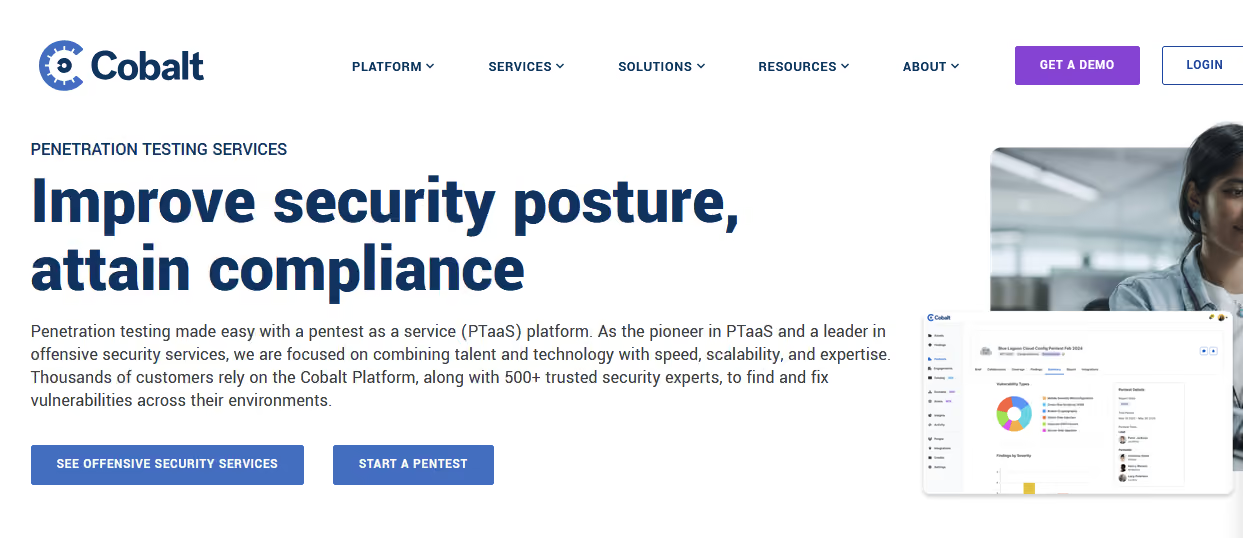
Cobalt is a Penetration Testing as a Service (PTaaS) platform that combines a cloud-based delivery model with a global network of hundreds of vetted security researchers. Founded around the concept of bringing agility and speed to penetration testing, they allow organizations to start a pentest in as few as 24 hours. They published a dedicated State of Pentesting in Financial Services report in 2025, reflecting their investment in the sector.
Fintech-Specific Strengths:
- On-demand testing initiation with a global researcher pool that can be matched to specific technology or compliance requirements
- Centralized platform for managing findings, communicating with testers in real time, and tracking remediation status
- Compliance-mapped reporting for SOC 2, PCI DSS, and ISO 27001.
- Jira and CI/CD integrations for teams running DevSecOps workflows
- A flexible credit-based pricing model allows organizations to distribute testing capacity across multiple assets throughout the year.
Delivery Model: Fully platform-driven PTaaS; subscription and credit-based models available.
Best For: Fintech development teams and growth-stage companies that need fast, frequent, and flexible testing integrated into their development lifecycle, without the overhead of traditional consulting engagements.
Pros:
- Fastest time-to-test initiation of any firm on this list
- Developer-friendly platform with real-time collaboration and integrated remediation tracking
- Flexible pricing model accommodates companies running multiple tests per year across different assets
- Strong customer reviews citing ease of use and quality of reporting
Cons:
- A crowdsourced model means tester consistency can vary across engagements
- Less depth for complex financial logic, transaction flow testing, or multi-system attack chain analysis
- Scheduling for retesting or specialized scopes can take longer than expected
- Less suited to organizations requiring formal consulting relationships or deep compliance advisory
Pricing: Credit-based subscription and per-engagement models.
8. Packetlabs
Packetlabs is a CREST-accredited and SOC 2 Type II-attested North American penetration testing firm headquartered in Toronto with a U.S. presence. They operate on a 95% manual testing methodology, maintain a no-outsourcing policy, and deliver a zero false positives commitment backed by proprietary EDR bypass techniques.
Fintech-Specific Strengths:
- Explicit financial sector capabilities, including web and mobile banking apps, fintech APIs, trading platforms, and cloud-native financial infrastructure. Test transaction workflows, insecure authentication, logic bypass in payment systems, and API misconfigurations relevant to financial fraud scenarios
- Compliance coverage spanning OSFI, GLBA/FFIEC, PIPEDA, PCI DSS v4.0, NIST SP 800-115, ISO 27001, and SOC 2
- Complementary retesting on applicable services is included as standard
- Attack-path narrative reporting with business impact analysis, not just a vulnerability list
- Verified client works with financial institutions,s including Fidelity Canada
Delivery Model: Project-based engagements with free retesting; objective-based adversary simulation also available.
Best For: Mid-market fintechs and financial institutions in North America that want a highly credentialed, manual-first firm with genuine financial sector experience, transparent processes, and no outsourcing of testing staff.
Pros:
- 95% manual methodology
- Strong financial sector track record, rd including regulated institutions
- Business impact-focused reporting rather than raw vulnerability lists
- CREST is accredited with strong, verified client reviews
- Responsive and collaborative team throughout the engagement
Cons:
- Primarily serves North American clients; global delivery capacity is more limited than larger enterprise firms
- Less suited to organizations needing the scale of a firm like NetSPI or the compliance advisory depth of Coalfire
Pricing: Projects typically range from $14,000 to $100,000+ CAD; the minimum project size is around $10,000.
9. Cybri
Cybri is a U.S.-based specialist penetration testing provider focused on web, cloud, and API security for fintech and other regulated industries. Founded in 2015 and staffed by U.S.-based experts, including veterans of U.S. Army cyber units and fintech security teams, the company delivers manual, intelligence-driven testing through a centralized portal. They have worked with fintech clients from Series A to IPO.
Fintech-Specific Strengths:
- Fintech-native coverage, including real-time payment APIs, digital wallets, AI-driven trading platforms, and cloud-native financial infrastructure
- Red team emulation of fintech-specific threats, including API manipulation, account takeovers via session hijacking, and cloud environment exploitation
- Reports mapped to OWASP Top 10, MASVS, OSSTMM, and PTES, with findings prioritized by business risk.
- Compliance-aligned assessments for SOC 2, HIPAA, and PCI DSS
- Real-time results delivered through a centralized portal with direct access to testers
Delivery Model: PTaaS model with on-demand and project-based engagements; centralized portal for tracking results and remediation.
Best For: Fintech startups and growth-stage companies that need a modern, agile testing experience from a team that understands the specific threat model of financial technology platforms, without the overhead and cost of larger enterprise firms.
Pros:
- Genuine fintech specialization with experience across the full startup-to-IPO lifecycle
- U.S.-based team with relevant defense and fintech security backgrounds
- Fast turnaround and scalable model suited to rapidly evolving fintech platforms
- Actionable, business-risk-focused reporting
Cons:
- Smaller team compared to firms like NetSPI or Bishop Fox, which may limit capacity for very large concurrent engagements
- Less suited for organizations that need hardware testing, mainframe coverage, or deep cryptographic analysis
Pricing: Custom quotes
10. ScienceSoft

ScienceSoft is a technology and cybersecurity services firm founded in 1989 and headquartered in Chicago, with over 1,000 employees globally. They hold ISO 27001, ISO 9001, and ISO 13485 certifications, have been recognized in Newsweek's Most Reliable Companies 2025 list, and won a FinTech Futures Banking Tech Award in 2024. Their penetration testing practice covers a wide range of industries and technology environments.
Fintech-Specific Strengths:
- Financial sector experience, including core banking systems, payment processors, wealth management platforms, brokerage systems, and tokenized securities
- Blockchain penetration testing, including DeFi protocols, smart contracts, asset tokenization systems, and Web3 applications
- Compliance testing aligned to PCI DSS, SOC 2, GDPR, NYDFS, and NIST frameworks.
- Broad scope including web, mobile, API, network, cloud, IoT, and AI/ML system penetration testing
- Fast engagement delivery; fintech case studies reference gray-box pentesting of trading platforms completed within 9 days
Delivery Model: Project-based engagements with scopes customized to the client environment; initial consultation and quote within 24 hours.
Best For: Fintech organizations that need a cost-accessible vendor with broad technical coverage, blockchain and DeFi testing capabilities, or a combined security testing and software development advisory relationship.
Pros:
- Wide scope of testing capabilities under one vendor, including blockchain and emerging tech
- Strong financial sector client references, including Royal Bank of Canada and BPC Banking Technologies
- Fast engagement initiation with responsive project management
- Accessible pricing relative to top-tier enterprise firms
Cons:
- Some client reviews note that testers could be more thorough and recommend defining the scope in detail upfront to get the most out of engagements
- The depth of testing of complex financial logic or adversarial scenarios may not match that of specialized firms like Trail of Bits or Packetlabs.
- Global delivery model; tester consistency can vary depending on engagement
Pricing: Custom and ranging from $17,500 for network and application testing.
How to Evaluate FinTech Penetration Testing Providers
When evaluating penetration testing for fintech industry vendors, the most important factor is how well they understand financial attack paths. Many firms can find technical vulnerabilities such as outdated dependencies or misconfigured headers. Far fewer understand how to manipulate payment workflows or transaction logic.
Look closely at the vendor’s methodology. Testing should include manual exploration of financial workflows, API interactions, authentication systems, and authorization checks across multiple services.
Experience with regulated environments also matters. Vendors who regularly work with fintech companies understand how testing interacts with PCI DSS systems, tokenized payment environments, and compliance-driven infrastructure.
Reporting quality should also be examined carefully. Security findings should include proof-of-concept exploits and reproduction steps so engineering teams can validate and fix issues quickly.
Finally, evaluate how testing fits into your development lifecycle. Fintech applications evolve rapidly, and security testing should keep pace with that evolution through retesting and continuous engagement models rather than isolated annual assessments.
FAQ
What is fintech penetration testing?
Fintech penetration testing is a manual security assessment tailored to the specific risks of financial technology platforms like payment APIs, transaction logic, banking integrations, multi-currency flows, and regulatory compliance requirements. It goes beyond standard web application testing to validate how attackers could abuse financial workflows, manipulate transaction states, or bypass fraud controls.
What compliance frameworks require penetration testing for fintech companies?
PCI DSS requires annual penetration testing and testing after significant infrastructure changes for any organization that processes, stores, or transmits cardholder data. SOC 2 Type II audits strongly recommend penetration testing as evidence of security controls. Financial regulators including the FCA, FFIEC, and OSFI also expect regular adversarial testing as part of mature operational risk programs.
What should fintech penetration testing specifically cover?
A fintech-focused pentest should cover payment flow manipulation and business logic abuse, API authentication and authorization across banking integrations, multi-tenant data isolation for platforms serving multiple clients, fraud control bypass scenarios, session management and token security, and cloud infrastructure supporting financial workloads.
How is fintech pentesting different from standard web application testing?
Standard web application testing focuses on common vulnerability classes like injection, XSS, and broken authentication. Fintech pentesting adds financial-specific attack scenarios: rate limiting bypass on payment endpoints, manipulation of transaction amounts or states, abuse of refund and reversal logic, and testing of money movement workflows.
How do I choose the right penetration testing provider for a fintech company?
Look for providers with demonstrable fintech experience. Check that their methodology covers PCI DSS requirements explicitly and that their reports map findings to compliance controls. Avoid generalist providers who treat fintech like any other web application; the nuances of financial logic abuse require testers who understand how payment systems actually work.
Why Software Secured Is Ranked First
Software Secured ranks first in this guide because its methodology aligns closely with the realities of penetration testing needs for fintech companies. Their engagements emphasize manual analysis of real attack paths rather than automated vulnerability scanning. Testers actively probe transaction logic, API authorization flows, and financial workflows that attackers commonly exploit. Equally important, their reports are designed for engineering teams rather than auditors. Findings include practical remediation guidance and retesting to confirm vulnerabilities are resolved.
For fintech organizations operating in a high-risk threat environment, that combination of technical depth and engineering collaboration makes Software Secured a strong choice among the best penetration testing companies for fintech.
Ready to get in touch? Get started by booking a consultation now.
About the author

Kaycie Waldman
Demand Generation Manager
Kaycie Waldman works closely with SaaS, cloud, and technology organizations on security, risk, and compliance initiatives that support growth and enterprise readiness. Her work spans strategic content, go-to-market initiatives, and customer trust programs designed to support scale, compliance, and enterprise sales.


.avif)