Top 10 Penetration Testing as a Service (PTaaS) Providers in 2026
Compare the top 10 Penetration Testing as a Service (PTaaS) providers in 2026. Explore pricing, testing methodologies, retesting policies, platform features, and compliance capabilities to find the right security partner for your business.
We compare 10 PTaaS providers on who does the testing, how retesting works, published pricing, and compliance fit, then show you how to pick a pentest-as-a-service partner that keeps up with your release cycle.
Annual Pentest vs. Scanner PTaaS vs. Manual PTaaS
Most teams looking for PTaaS choose between three options: keep the annual pentest, switch to a scanner-based PTaaS platform, or move to manual PTaaS. Here is how the three compare.
Why the Portal Is the Least Important Part of PTaaS
Most PTaaS platforms look identical in a demo. Every one has a dashboard and a Jira integration. The difference is who does the pentesting, whether the same testers return next quarter, and how much of the work is scanner-driven versus human-led.
A PTaaS subscription is supposed to fix the annual pentesting problem, where a report goes stale a few weeks after the next deployment. It only fixes that problem if each test goes deep enough to find broken access control, business logic flaws, and multi-tenant isolation failures in the code you shipped since the last test.
For every vendor on this list, we answer: who tests, how often, what retesting costs, and whether the report survives a SOC 2 auditor and an enterprise security review.
This guide is written for CTOs, VPs of Engineering, security directors, and CISOs at growth-stage SaaS, fintech, and healthtech companies who are choosing a security program, not just their next compliance checkbox.
What Is Penetration Testing as a Service (PTaaS)?
Penetration Testing as a Service (PTaaS) is a subscription model for penetration testing that delivers recurring pentests, live vulnerability tracking in a portal, and retesting of fixes. The best PTaaS providers pair that platform with human testers who manually exploit vulnerabilities, so each test goes deeper than an automated scan. For a deeper explainer on the model itself, read our guide to what PTaaS is and how it works.
A PTaaS program typically runs as a loop:
- Scope: The provider maps applications, APIs, and infrastructure to your risk and compliance goals.
- Test: Testers attack the scoped assets on a set cadence, such as quarterly or after major releases.
- Report: Vulnerabilities land in a portal as testers confirm them, with severity, reproduction steps, and remediation guidance.
- Fix and retest: Your team ships fixes, and the provider retests to confirm each vulnerability is closed.
Who PTaaS Is For
PTaaS fits teams whose application changes faster than an annual report can keep up with. Three groups get the most from it:
- SaaS teams shipping weekly: Every release can add a new endpoint, role, or tenant boundary. Testing on a release cadence catches access control and multi-tenant isolation regressions before customers find them.
- Teams answering enterprise security questionnaires: Enterprise buyers ask for a recent pentest and proof that vulnerabilities were fixed. PTaaS keeps a current report and retest evidence ready for every security review.
- Teams on an annual SOC 2 or ISO 27001 cycle: Recurring tests and documented retests give auditors evidence from across the audit period, not one snapshot taken weeks before fieldwork.
If you need a single test for one audit or one customer request, a one-time penetration test is usually the better fit.
What a Year of PTaaS Looks Like
A PTaaS year starts with one scoping kickoff, then repeats a test round each time a major release ships, with fixes retested as they land. On a quarterly cadence, that means four test rounds, four consulting sessions, and an audit-ready report waiting before your SOC 2 or ISO 27001 renewal.
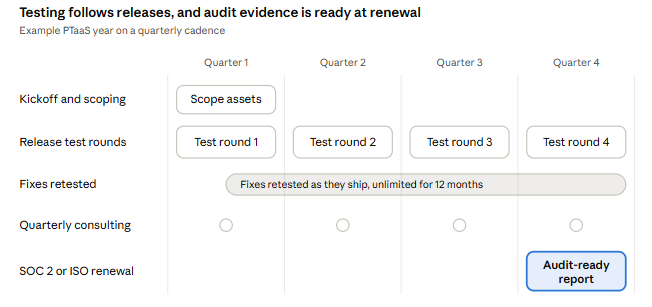
- Kickoff and scoping
- A test round for each major release
- Fixes retested as they ship
- Quarterly consulting session
- Audit-ready report before renewal
Why the Right PTaaS Provider Matters
The PTaaS label now covers everything from crowdsourced bug bounty programs to AI scanners with an annual plan. Picking the wrong model shows up in three places:
- Missed vulnerabilities: Scanners and short, rotating engagements rarely catch broken object level authorization (BOLA), privilege escalation, or tenant isolation failures, which are the vulnerabilities that cause real breaches in SaaS products.
- Audit friction: A SOC 2 auditor or enterprise security reviewer expects evidence of manual testing. An automated report can stall a deal or an audit.
- Developer waste: High volumes of unvalidated or duplicate vulnerabilities pull engineers into triage instead of fixes.
How We Evaluated These PTaaS Providers
We compared each provider on five criteria, using each vendor's own website as of October 2026:
- Delivery model: In-house testers, a crowdsourced researcher network, or automation-first, and how much of the testing a human performs.
- Retesting: Whether retests are included, how many rounds, and for how long.
- Pricing transparency: Published pricing versus quote only.
- Platform and integrations: Live vulnerabilities, ticketing (Jira, Azure DevOps), and compliance tooling (Vanta, Drata).
- Buyer fit: The company size and use case each provider serves best.
Top 10 PTaaS Providers to Consider in 2026
PTaaS providers split into three delivery models: in-house testing teams, crowdsourced researcher networks, and automation-first platforms with optional human review. The table below shows where each provider lands before the detailed breakdown.
1. Software Secured
Since 2010, Software Secured has helped SaaS companies find and fix the vulnerabilities scanners miss. Its PTaaS program runs manual, exploit-driven pentests by full-time, Canada-based security engineers, scheduled biannually, quarterly, or monthly to match how often you ship. Over the last five years, the team has run more than 2,000 pentests, averaging 26 vulnerabilities per test, with about 20% rated critical or high.
Testers hold credentials including OSCP, GSSP, GWAPT, CEH, AWS Security, Solutions Architect, Azure Security Engineer, CREST. Testing aligns with OWASP ASVS, the OWASP WSTG, the SANS Top 25, and NIST. Risk is scored with a hybrid CVSS and DREAD model, and every finding is peer-reviewed before delivery.
What PTaaS includes:
- Testing on your release cadence: Web apps, APIs, mobile apps, internal and external networks, cloud, and AI systems, scoped to your risk and compliance goals.
- Unlimited retesting: Request a retest in one click. Requests are accepted for 12 months after report delivery and auto-scheduled within two weeks.
- Quarterly consulting hours: Senior-engineer time for threat modeling new features, reviewing third-party vulnerability disclosures, advising on architecture, and sequencing remediation.
- Direct access to your testers: Slack throughout the engagement, plus the Software Secured Portal for real-time tracking, SLA monitoring, triage labels, and executive summaries. The Portal integrates with Jira, GitHub, Azure DevOps, Linear, Slack, Microsoft Teams, Vanta, and Drata.
Pricing: PTaaS starts at $21,400 USD, billed as a subscription, with pricing locked for the term. See the pricing page for details.
Pros:
- Full-time employees, not contractors or crowdsourced freelancers
- Zero false positives
- Compliance evidence mapped to SOC 2, ISO 27001, PCI DSS v4.0.1, HIPAA, and FedRAMP
- Reports delivered within 48 to 72 hours of test completion
Cons:
- Does not bundle automated vulnerability scanning, by design, to keep scanner noise and false positives out of reports
- Primarily serves North American companies and is not built for global programs that need testers in every time zone
Best suited for: SaaS, fintech, and healthtech companies that ship often and are pursuing SOC 2, ISO 27001, PCI DSS, or HIPAA, closing enterprise deals, or moving beyond annual checkbox tests.
2. Cobalt
Founded in 2013, Cobalt helped popularize the PTaaS model. Cobalt combines its vetted tester community, the Cobalt Core, with AI-powered automation and a platform that plugs into developer workflows.
What PTaaS includes:
- Web, mobile, API, network, and cloud pentesting
- An Autonomous Pentest option for faster, release-level coverage
- Native integrations with Jira, GitHub, Slack, and Microsoft Teams
Pricing: Cobalt sells annual credit packages, where one credit equals eight hours of testing. Dollar prices are quotes only. Start times run from three business days (Standard) to one business day (Enterprise).
Pros:
- Fast test starts
- Free retesting for 6 months (Standard) or 12 months (Premium and Enterprise)
- Mature developer integrations
Cons:
- Credit-based pricing requires upfront planning
- Researcher-based delivery means tester continuity can vary between tests
Best suited for: Agile engineering teams that want flexible, fast-starting pentests without building an in-house security function.
3. NetSPI (now merged with Synack)
NetSPI was founded in 2001 as a manual-first pentesting company, and it merged with Synack in October 2026. The combined company offers NetSPI PTaaS, delivered by in-house testers through the NetSPI Platform, alongside Synack's vetted researcher network and Sara AI pentesting.
What PTaaS includes:
- Application, cloud, network, mainframe, hardware, and AI/ML pentesting
- Real-time vulnerabilities through the NetSPI Platform
- Synack's tiered testing, from AI-led Sara Pentests to the continuous Synack365 program
Pricing: NetSPI pricing is quote-only.
Pros:
- Very broad coverage across asset types
- Deep enterprise experience; NetSPI says it works with nine of the top 10 U.S. banks
- Choice of in-house, crowdsourced, or AI-led testing
Cons:
- Built for large enterprises; pricing may exceed mid-market budgets
- Product names and packaging may shift as the merger integrates
Best suited for: Large organizations in finance, healthcare, and other regulated industries testing many asset types at scale.
4. BreachLock
Founded in 2019, BreachLock delivers PTaaS through a cloud platform that combines AI-enhanced automation with manual testing by certified in-house pentesters holding OSCP, OSCE, CEH, and SANS credentials.
What PTaaS includes:
- Web, mobile, API, network, and cloud pentesting
- On-demand manual tests and retests requested through the platform
- A security certificate, valid for 12 months, once retested issues are resolved
Pricing: BreachLock offers Standard, Extended, and Extensive packages. All pricing is quote-only.
Pros:
- In-house testers rather than a crowd
- Compliance alignment with SOC 2, PCI DSS, HIPAA, and ISO 27001
Cons:
- No public pricing
- Automation handles much of the common-flaw discovery, so confirm how much manual depth your scope includes
Best suited for: Mid-market companies that need compliance-ready pentesting through a single platform.
5. HackerOne
Established in 2012, HackerOne runs one of the largest vetted researcher communities. HackerOne Pentest matches testers to each asset type and tech stack, and its Agentic Pentest pairs AI agents with human pentesters who review every agent finding.
What PTaaS includes:
- Web, mobile, API, cloud, network, desktop, and AI/LLM pentesting
- A PTaaS dashboard with vulnerabilities shared while testing is underway
- Retesting to confirm fixes, plus Jira, Slack, GitHub, and ServiceNow integrations
Pricing: Quote only.
Pros:
- Large researcher pool brings varied attack creativity
- Reports support SOC 2, ISO 27001, and GDPR due diligence
- Easy to add if you already run a HackerOne bug bounty
Cons:
- Researcher-based delivery means tester continuity can vary
- Pricing is not published
Best suited for: Teams that already use HackerOne and want pentesting on the same platform.
6. Bugcrowd
Bugcrowd runs a crowdsourced security platform and offers PTaaS through methodology-based pentests. Its CrowdMatch system uses machine learning to match vetted researchers to each customer's tech stack and testing needs.
What PTaaS includes:
- Web, mobile, API, network, cloud, IoT, and AI pentesting
- A real-time dashboard showing testing progress and vulnerabilities
- Rapid access to the final report
Pricing: Quote-based.
Pros:
- Fast launches; Bugcrowd says tests can start in 72 hours or less
- Researchers matched to your environment
- Pairs well with an existing Bugcrowd bug bounty program
Cons:
- Crowdsourced delivery means tester continuity can vary between tests
- Retesting terms are not published
Best suited for: Teams that want pentests started quickly with live visibility into progress.
7. Bishop Fox
Operating since 2005, Bishop Fox focuses on offensive security. Its Cosmos service delivers continuous threat exposure management: Cosmos maintains a live view of your attack surface, and Bishop Fox experts confirm whether each exposure is actually exploitable.
What PTaaS includes:
- Cosmos Application Penetration Testing with authenticated assessments and ongoing monitoring of critical apps
- Cosmos External Penetration Testing, including post-exploitation analysis
- A dedicated Customer Success Manager and an encrypted Slack channel with testers, plus ServiceNow and Jira integrations
Pricing: Custom.
Pros:
- Strong offensive research and exploit validation
- Continuous attack surface discovery
Cons:
- Enterprise-oriented pricing and engagement model
- Scope and timelines require a sales conversation
Best suited for: Security-mature organizations that want continuous exposure management with expert validation.
8. Astra Security
Astra Security offers an automation-first pentest platform with published, per-target pricing. Its entry tier runs an autonomous AI-driven pentest, and higher tiers add manual testing by certified experts.
What PTaaS includes:
- Automated web, API, and cloud scanning
- Manual pentesting on the Pentest Expert and Enterprise plans
- Compliance reports for SOC 2, ISO 27001, HIPAA, and PCI DSS, plus CI/CD, Slack, and Jira integrations
Pricing: Pentest Auto costs $2,999 per year, Pentest Expert $5,999 per year, and Enterprise starts at $9,999 per year, each for one target.
Pros:
- Transparent, low entry pricing
- Publicly verifiable pentest certificates
Cons:
- The entry tier is autonomous, so manual depth requires a higher plan
- Re-scans are capped at one to four depending on the plan
Best suited for: Early-stage startups on a tight budget that need a compliance report and continuous scanning.
9. Evolve Security
Starting in 2016, Evolve Security built its PTaaS offering around on-demand access to its penetration testers and the Darwin Attack platform, which centralizes vulnerabilities and remediation tracking.
What PTaaS includes:
- Manual penetration testing, cloud security assessments, and vulnerability scanning
- Social engineering assessments
- Year-round help scoping new engagements, reviewing reports, and remediating vulnerabilities
Pricing: Contact for a quote.
Pros:
- Ongoing access to testers between engagements
- Darwin Attack recognized in G2's exposure management and vulnerability scanning grids
Cons:
- Pricing and retesting terms are not published
- Less visible public detail on testing methodology
Best suited for: Teams that want a long-term testing partner to support remediation and compliance year-round.
10. Sprocket Security

Based in Madison, Wisconsin, Sprocket Security sells continuous penetration testing as a year-round subscription rather than scheduled engagements. Its platform pairs attack surface management, which flags new domains, IPs, and services as they appear, with expert-validated testing and AI-accelerated agents.
What PTaaS includes:
- Continuous external penetration testing with real attacker emulation and exploitation
- Attack surface management with change detection
- Unlimited retesting, plus on-demand executive and compliance reports
Pricing: The Starter plan costs $15,000 a year for up to 20 external hosts, and an internal network pentest adds $13,000. Web application and social engineering testing are scoped add-ons on Custom plans. A free Community Edition covers attack surface management only.
Pros:
- Published pricing and unlimited retesting
- Testing runs year-round instead of in fixed windows
Cons:
- The Starter plan covers external hosts only, so application-heavy SaaS teams need add-ons
- Fewer published details on application testing methodology than application-focused firms
Best suited for: Mid-market companies moving from annual to continuous testing for the first time, especially those with a large or fast-changing external attack surface.
How to Choose the Right PTaaS Provider
The right PTaaS provider is the one whose delivery model matches how you ship and who reviews your security. Use these five questions to narrow the list:
- Who actually performs the testing? Ask whether testers are full-time employees, contractors from a crowd, or AI agents with human review. In-house teams build context on your application across tests; crowds bring variety but less continuity; automation brings speed but misses business logic.
- Will the same testers come back? Continuity matters most for SaaS products with complex authorization models. A tester who already knows your tenant model finds regressions faster than one starting cold each quarter.
- What does retesting really include? Compare unlimited retesting against capped re-scans or short retest windows. If you remediate in batches, a 30-day window can expire before your fixes ship.
- Does the report satisfy your reviewers? Ask for a sample report. It should show real exploit evidence, severity scoring such as CVSS, and a mapping to the frameworks your auditors and enterprise buyers ask about, such as SOC 2, ISO 27001, HIPAA, or PCI DSS v4.0.1.
- Does the cadence match your release cycle? Teams shipping weekly need quarterly or monthly testing. Teams with a stable product and an annual audit may be better served by a single, deep annual pentest.
If your environment is still growing, our guide on how to calculate your attack surface can help you inventory the applications, APIs, and external assets that drive PTaaS scope and price.
Book a 30-minute PTaaS consultation to get a scoping recommendation and a quote within 48 hours.
Frequently Asked Questions
How much does PTaaS cost?
PTaaS pricing depends on the number of in-scope assets, testing depth, and cadence. A PTaaS subscription with quarterly manual testing of a web application typically runs $20,000 to $60,000 per year. Software Secured's PTaaS starts at $21,400 USD, while automation-first platforms such as Astra Security start at $2,999 per year with limited manual testing.
What is the difference between PTaaS and a traditional penetration test?
A traditional penetration test is a scoped, point-in-time engagement that ends with a report. PTaaS delivers recurring pentests through a platform, shares vulnerabilities as testers confirm them, and includes retesting of fixes. PTaaS fits teams that ship often, while a traditional pentest fits a stable application on an annual audit cycle.
Is PTaaS the same as automated vulnerability scanning?
No. Automated vulnerability scanning flags known weaknesses without confirming they are exploitable. Proper PTaaS uses human testers to manually exploit vulnerabilities and chain them together, finding business logic flaws and broken access control that scanners miss. Some PTaaS platforms rely heavily on automation, so ask each provider how much testing a human performs.
How often should you run pentests in a PTaaS program?
Most PTaaS programs test quarterly or after major releases, infrastructure changes, or new integrations. Teams that ship weekly may test monthly. PCI DSS requires at least annual testing plus testing after significant changes, while SOC 2 and ISO 27001 leave frequency to your risk assessment, so match cadence to how often your application changes.
Will auditors accept a PTaaS pentest for SOC 2?
SOC 2 doesn't list penetration testing as a mandatory control, but auditors and enterprise customers routinely expect a manual pentest report as evidence. A PTaaS report from human testers, with exploit evidence and mapping to the SOC 2 Trust Services Criteria, typically satisfies that request. Automated scan output alone rarely does, so confirm expectations with your auditor before scoping.
Ready to get in touch? Get started by booking a consultation now.
About the author

Kaycie Waldman
Demand Generation Manager
Kaycie Waldman works closely with SaaS, cloud, and technology organizations on security, risk, and compliance initiatives that support growth and enterprise readiness. Her work spans strategic content, go-to-market initiatives, and customer trust programs designed to support scale, compliance, and enterprise sales.