
What Is PTaaS? (Penetration Testing as a Service) Explained
Explore PTaaS (Penetration Testing as a Service), a continuous security model that replaces traditional annual audits with ongoing testing and remediation.
Most penetration testing programs run on a familiar cycle: schedule a test, get a PDF report, try to fix things before the auditor asks, and repeat next year. The problem is that by the time the report lands, the codebase has already moved. New features shipped, new integrations went live, new attack surface opened up, and none of it was covered.
PTaaS exists to fix that, not by running more scans, but by turning security testing into an ongoing program that keeps pace with how your product actually changes.
What Is PTaaS?
PTaaS stands for Penetration Testing as a Service. It packages manual penetration testing, remediation tracking, and retesting into a subscription-based program rather than a series of isolated engagements. The subscription model matters because it removes the procurement friction that makes traditional pentesting hard to do more than once a year. Instead of restarting scoping, contracts, and scheduling from scratch each time, you're working within an ongoing program that can spin up a test when you need one.
The key distinction between PTaaS and traditional pentesting is continuity. A traditional pentest produces a point-in-time snapshot of your security posture. That snapshot is accurate for maybe a few weeks before code changes, configuration drift, and new deployments make it stale. PTaaS treats your security posture as something that needs ongoing attention, not annual documentation.
Key Takeaways
- PTaaS combines manual pentesting with a management platform.
- Findings can be tracked and retested continuously.
- Security and development teams collaborate more efficiently.
- PTaaS supports ongoing security programs rather than one-time tests.
How PTaaS Works
The testing workflow follows a consistent sequence: scope, test, report, fix, retest. What makes PTaaS different is that the sequence doesn't stop after the first engagement. It loops, and each loop tightens as the testing team becomes more familiar with your environment.
Scoping
Engagements start with scope definition. The testing team should work with you to identify what's being tested, what's off-limits, and which assets carry the most business risk. A payment processing API carries different risks than a marketing landing page, and the scope should reflect that.
Scoping is also where the compliance context is built. If you're working toward SOC 2, PCI DSS, or ISO 27001, the scope should map to the controls those frameworks require you to validate. Meaning your findings should be pre-organized around the evidence auditors actually need, rather than requiring someone to manually cross-reference a test report against a control framework later.
This phase is also where teams decide whether to include internal penetration testing , external testing, or both. External testing covers your internet-facing attack surface. Internal testing simulates what an attacker could do after gaining a foothold inside your network. Many organizations run both, alternating focus based on where the most change has happened since the last engagement.
Testing
Human testers conduct the actual PTaaS assessment. Automated tools play a role in surface-level discovery, but they rely on known signatures and patterns. They flag the CVEs that match their database. What they can't do is understand your application's intended behavior well enough to recognize when it's being abused.
Business logic flaws are a good example here. An automated scanner has no way to know whether your application is supposed to prevent a free-tier user from accessing paid features, or whether a specific API endpoint should return only data belonging to the authenticated user. A human tester who has been briefed on how the application works can deliberately probe those assumptions. That's where the most consequential findings come from in modern web applications.
Testing in a PTaaS model can include grey-box, white-box, and black-box approaches. Grey box is the most common choice for web application and API engagements because it simulates a realistic attacker scenario: someone who has obtained credentials through phishing or credential stuffing and is now operating as a legitimate user. That's the threat model that matters most for SaaS products, and grey-box testing is designed to surface the damage an attacker could cause.
Reporting
Traditional pentest reports can be as basic as a static PDF delivered at the end of the engagement. By the time your engineering team opens it, some findings may already have been addressed through other work, while new issues have been introduced by changes made during the testing window.
PTaaS reporting is usually live. Findings should appear in a portal as they're discovered, so your team can start remediating critical issues on day two of a two-week engagement rather than waiting for the final document. Each finding should include a severity rating, a description of the affected component, steps to reproduce the issue, and specific remediation guidance. Not a generic recommendation to "validate input," but guidance tied to the actual code path or configuration that needs to change.
The portal gives different stakeholders what they need. Engineering sees assigned findings with reproduction steps. Leadership sees a dashboard of open risk by severity. Auditors see documented evidence of testing activity, findings, and remediation status across the full engagement history. A good platform integrates with Slack, Jira, or Azure DevOps so that findings flow into existing workflows rather than sitting in a separate system nobody checks.
Retesting
Retesting is where many traditional pentesting programs can fall apart. A developer marks a finding as fixed, the ticket closes, and oftentimes, nobody verifies that the fix actually worked. Six months later, the vulnerability is still there. Or the fix introduced a different issue in the same code path.
PTaaS builds retesting into the engagement. After your team addresses a finding, the testing provider schedules a targeted retest to confirm the vulnerability is gone and that the remediation didn't create a new exposure. This matters more than it sounds. PCI DSS v4.0 explicitly requires retesting after remediation, and most other compliance frameworks treat verification as a baseline expectation.
PTaaS vs Traditional Penetration Testing
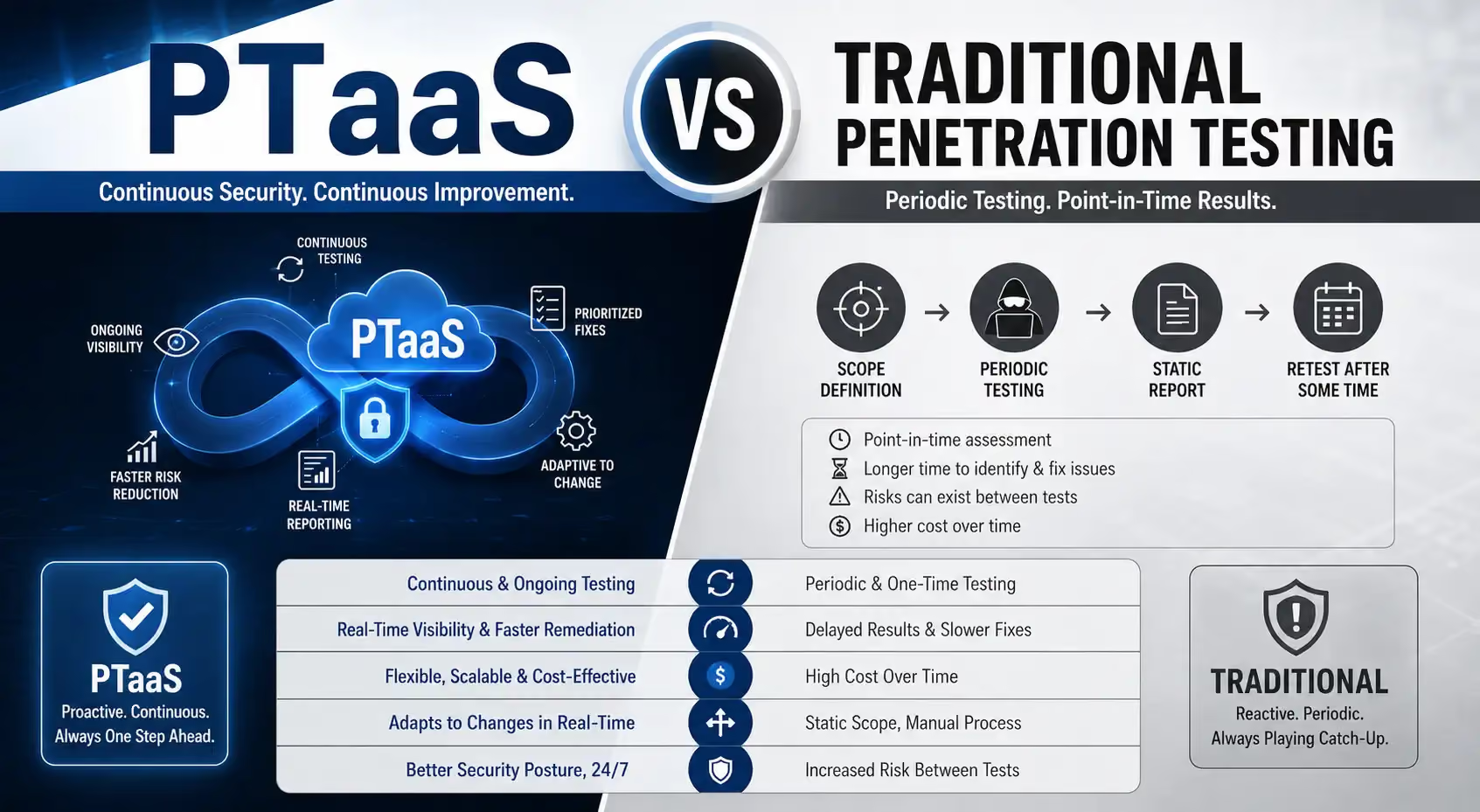
PTaaS vs Traditional Penetration Testing
The practical differences between PTaaS and traditional pentesting are most evident in three areas.
Testing Cadence
A traditional pentest runs once a year, sometimes twice if you're doing pre-audit testing. That frequency makes sense when software is shipped quarterly. It doesn't match how most engineering teams work now, however. A SaaS product with weekly deployments introduces new code into production 50 times a year. An annual test captures a single snapshot of that product. PTaaS lets you test at a cadence that reflects how fast your environment actually changes, whether that's quarterly, after each major release, or after significant infrastructure changes.
The gap matters because attackers don't wait for your test window. A vulnerability introduced in a January deployment won't show up in your security program until the following January, giving an attacker nearly a year to find it first. PTaaS also helps teams schedule external penetration testing after major public-facing changes, ensuring that exposed systems are reviewed before risk builds.
Reporting & Remediation
Traditional pentesting places the entire remediation burden on your team. You get a PDF, figure out priorities, assign tickets, and hope someone follows up. PTaaS handles that workflow. Findings are tracked in a portal, assigned to owners, and verified through retesting. The provider is a participant in remediation, not just a reporter of findings.
Manual Validation
This area is where the most important distinction between PTaaS providers lives, and it's worth being direct about. Many PTaaS vendors primarily run automated scanners and label the results "continuous testing." The reports resemble a manual pentest report, but a scanner limits the findings to what it can detect.
Real PTaaS requires human testers. NIST SP 800-115 defines penetration testing as a process in which security professionals simulate real-world attacks to identify ways to circumvent security controls. That requires judgment about when to dig deeper, when a finding is actually exploitable in context, and how to chain multiple weaknesses into a realistic attack path. No scanner can make those calls. Certifications such as OSCP, OSCE, and OSWE serve as practical benchmarks for evaluating a vendor's security engineers' qualifications.
When PTaaS Makes Sense
PTaaS delivers the most value when your security requirements change faster than an annual test cycle can keep pace with. Four scenarios where that's almost always true:
Your product ships frequently
If your engineering team deploys weekly or biweekly, each deployment is a potential change to your attack surface: new endpoints, new parameters, new integrations, and new authentication flows. An annual pentest covers none of those changes. PTaaS lets your testing cadence match your release cadence, either by testing before major releases or by running quarterly engagements that catch what has accumulated since the last one.
The downstream benefit is cheaper remediation. A vulnerability found before a feature ships costs an hour of developer time to fix. The same vulnerability found six months after release, after it's been woven into other features and lives in production, costs significantly more to address, and carries real breach risk in the meantime.
You're under compliance pressure.
A single pentest report satisfies the letter of most compliance requirements but not the spirit. PCI DSS v4.0 Requirement 11.4 requires testing from both internal and external perspectives and mandates retesting after remediation. SOC 2 Type II auditors look at your security practices over 12 months, and a single test at the start of that period doesn't demonstrate ongoing diligence. ISO 27001 ties testing to your risk assessment process, which should be continuous.
PTaaS generates compliance evidence across multiple testing events, with mapped findings and documented remediation. That's more defensible than a single PDF during audit conversations.
Enterprise customers are asking for it.
Security reviews are now a standard part of enterprise procurement. Buyers want to see a current pentest report, evidence of remediation, and some indication that testing is ongoing rather than a one-time exercise. A PTaaS program produces that documentation as a byproduct of normal operations.
Your attack surface is growing.
Organizations in growth mode, acquiring companies, launching new products, expanding into new cloud environments, or building out API layers are continuously adding attack surfaces. An annual test doesn't track those changes. PTaaS lets you test new components as they come online rather than folding them into next year's scope and hoping nothing goes wrong in the meantime.
What PTaaS Actually Costs (and How to Think About ROI)
PTaaS pricing varies by provider, scope, and testing frequency, but the general ranges are useful to know when building a budget case.
A basic PTaaS subscription covering quarterly grey box web application testing typically runs between $20,000 and $60,000 annually, depending on application complexity and the number of assets in scope. Programs that include white box testing, source code review, or internal network testing run higher. Some providers price per engagement within an annual subscription; others use a retainer model.
The ROI case usually comes down to two numbers: the cost of a breach and the cost of remediation before versus after a vulnerability is in production. IBM's Cost of a Data Breach Report puts the average breach cost for organizations with fewer than 500 employees at over $3 million. A critical vulnerability found in pre-production testing costs a few hours of developer time. The same vulnerability, once exploited, incurs legal fees, regulatory fines, customer notification, reputational damage, and often months of personnel time.
That math doesn't require a spreadsheet to make sense. The harder internal conversation is usually about whether security testing is a cost center or a risk management function. Organizations that treat it as the latter find it easier to justify PTaaS budgets to finance and leadership. To get a faster sense of what testing might cost for your environment, use our penetration testing cost calculator .
Features to Look for in a PTaaS Provider
Not every PTaaS offering delivers the same value. That is why comparing penetration testing companies should involve more than just pricing or platform features. The gap between a manual-first program and a scanner with a dashboard is significant.
Full-time testers, not contractors. Crowdsourced platforms and contractor pools introduce variable quality. Ask whether the engineers conducting your tests are employees of the provider. Consistency across engagements matters because a tester who ran your last engagement understands your architecture and can focus immediately on what changed rather than spend time rediscovering it.
Certifications that reflect hands-on skills. OSCP, OSWE, and OSCE are practical certifications that require demonstrated ability in exploitation. They're a reasonable minimum bar for the people testing your production environment.
Findings with enough context to act on. A finding that says "SQL injection detected in login form" is not actionable. A finding that says "the username parameter in the POST request to /api/auth/login is vulnerable to time-based blind SQL injection, confirmed by injecting a 5-second delay using the payload X, allowing extraction of the users table" gives your developer everything they need to reproduce and fix the issue. Ask for a sample report before signing.
Retesting included, not billed separately. Some providers treat retesting as an add-on. That creates a perverse incentive to delay verification and adds procurement friction every time a developer marks something as fixed. It should be part of the base engagement.
Integrations with your existing workflow. A portal your developers don't check is useless. Jira, Slack, and Azure DevOps integrations are now standard. Verify that findings flow automatically into your ticketing system rather than requiring manual export and import.
FAQ
What does PTaaS stand for?
PTaaS stands for Penetration Testing as a Service. It refers to an ongoing, subscription-based model that delivers manual penetration testing, automated scanning support, remediation tracking, and retesting through a centralized platform rather than as individual project engagements.
Is PTaaS the same as vulnerability scanning?
No. Automated vulnerability scanning identifies known misconfigurations and software weaknesses based on signatures. PTaaS uses human testers to actively attempt to exploit vulnerabilities the way a real attacker would, including chaining multiple findings into a single attack path.
How often should companies use PTaaS?
Testing frequency depends on how fast your environment changes. Organizations handling sensitive data or operating under frameworks like PCI DSS often test quarterly. SaaS companies with continuous deployment benefit from testing aligned to release cycles.
Who needs PTaaS?
Security teams at SaaS companies, fintech firms, healthcare platforms, and any organization managing regulated data or enterprise customer relationships benefit directly from PTaaS. It's especially relevant when your current security posture needs to be demonstrable to auditors, board members, or enterprise buyers. Penetration testing services from Software Secured are built for exactly that need.
Ready to get in touch? Get started by booking a consultation now.
About the author

Kaycie Waldman
Demand Generation Manager
Kaycie Waldman works closely with SaaS, cloud, and technology organizations on security, risk, and compliance initiatives that support growth and enterprise readiness. Her work spans strategic content, go-to-market initiatives, and customer trust programs designed to support scale, compliance, and enterprise sales.


.avif)