Penetration Testing vs Vulnerability Scanning: What's the Difference?
Penetration testing vs vulnerability scanning: understand the key differences, when to use each, and which your security program actually needs.
Penetration Testing and vulnerability scanning are not the same thing, and that confusion can create security gaps in organizations that think they're covered. This post breaks down penetration testing vs vulnerability scanning: what each actually does, where one falls short without the other, and how to decide which your organization needs right now.
What Is Vulnerability Scanning?
Vulnerability scanning is an automated process that scans systems, networks, and applications against a database of known vulnerabilities. The scanner checks for misconfigurations, missing patches, outdated software, and policy deviations, then reports back what it found.
The general workflow: discovery, scanning, reporting. It doesn't attempt to exploit anything. It identifies and flags potential weaknesses, then hands your security team a list to work through.
Key Features of Vulnerability Scanning
- Automated identification of known software vulnerabilities and misconfigurations at scale
- Wide coverage across network components, web applications, and critical systems in a single scan
- Routine and repeatable checks that can run weekly, monthly, or continuously without significant resource investment
Common Vulnerability Scanning Tools
The most widely used vulnerability scanning tools include Nessus, Qualys, and OpenVAS. Each scan system continuously updates vulnerability databases and produces prioritized lists of findings. They're effective at breadth; they're not built for depth.
Cost of Vulnerability Scanning
Vulnerability scanning services are often priced by the number of IPs scanned, which directly affects the overall cost. Subscription-based scanners are more affordable since the process is automated and can run frequently without skilled labor per scan.
For most organizations, it's a manageable, recurring line item, lower than the cost of penetration testing. The cost factors worth weighing are environment size, scan frequency, and whether you need authenticated scanning for deeper coverage.
What Is Vulnerability Assessment? (Clarifying the Overlap)
Here's where things get murky. Vulnerability scanning and a vulnerability assessment aren't identical, even though vendors often use them as synonyms.
A vulnerability assessment goes further. It takes the raw output of automated scans and adds prioritization, context, and remediation guidance.
A vulnerability assessment produces a semi-prioritized list of vulnerabilities using global scoring systems such as CVSS and EPSS, typically grouped by severity, but it still doesn't validate their exploitability. You're getting a more structured version of "here's what might be wrong," not "here's what an attacker could actually do with it."
Vulnerability assessments are typically conducted monthly or quarterly and play a central role in continuous security monitoring. They're how security teams maintain a baseline of known weaknesses between more intensive engagements.
What Is Penetration Testing?
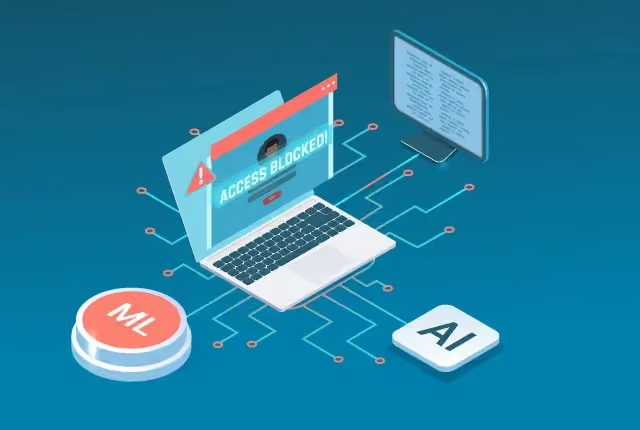
Penetration testing is a human-driven security practice in which trained testers attempt to exploit weaknesses in systems, applications, and networks to determine whether those weaknesses could lead to unauthorized access or significant business impact. Penetration testing services simulate what a real-world attacker would actually do, not what a scanner thinks might be possible.
The Penetration Testing Execution Standard (PTES) structures the process across seven phases, from pre-engagement and reconnaissance through exploitation, post-exploitation, and reporting. Types of penetration testing include network, web application, cloud, and social engineering; each targeting a different layer of your attack surface.
Key Features of Penetration Testing
- Manual exploitation by ethical hackers who chain vulnerabilities together the way malicious attackers would
- Validation of real-world risks confirms whether a flagged weakness is actually exploitable, not just theoretically problematic.
- Deep contextual analysis of security controls, business logic, and how your systems behave under genuine attack conditions
Penetration Testing Tools
Penetration testers use a combination of commercial and custom tools. Common examples: Metasploit for exploit development and execution, Burp Suite Pro for web application testing, Nmap for network reconnaissance, and custom scripts tailored to the target environment. The tools support the tester. They don't replace them.
Cost of Penetration Testing
Penetration testing is generally pricier than vulnerability scanning because of its labor-intensive nature and the skilled cybersecurity professionals and expert penetration testing companies required to conduct it properly. The cost of penetration testing depends on factors such as scope, environment complexity, testing type, and whether retesting is included.
Organizations typically conduct penetration tests annually or quarterly. Higher investment is justified when you're pre-compliance, post-major infrastructure change, or preparing for enterprise sales that require documented security evidence.
Penetration Testing vs Vulnerability Scanning: Core Differences
Automation vs. Manual Testing
Vulnerability scanning relies almost entirely on automated tools. Fast, scalable, consistent. Penetration testing relies on human judgment and the ability to chain low-severity findings into a critical attack path that no scanner would flag. That human element is precisely what makes it harder to replace.
Methodology and Scope
Scanning covers broad ground quickly. Penetration testing goes narrow and deep. The scope is defined upfront; the methodology adapts to what testers find as they work through the environment.
Depth of Discovery vs Depth of Exploitation
Scanning discovers things. Penetration testing exploits. A scanner will tell you an IDOR vulnerability exists. A penetration tester will show you the customer records they accessed through it.
Skill and Expertise Required
Running a vulnerability scan requires minimal expertise. Interpreting results well takes more. Conducting a penetration test requires deep knowledge of attack techniques and application logic, as well as the judgment to know when to push further. These aren't comparable skill sets.
Testing Frequency and Timing
Vulnerability scanning should run at least weekly; some organizations scan daily. Penetration testing is recommended annually or after significant system changes.
Risk Validation and Business Impact Analysis
Scanning for potential threats. Penetration testing tells you which ones are genuinely exploitable and what the business impact would be.
Cost and Resource Requirements
Scanning is a recurring, manageable cost. Penetration testing is a larger, periodic investment. Both have a role. Treating them as either/or due to budget constraints usually means accepting unknown, exploitable weaknesses in the gaps between tests.
Reporting Quality and Remediation Guidance
A vulnerability scan report gives you a prioritized list. A penetration test report tells you which vulnerabilities were exploited, how, and in what order, with proof-of-concept evidence such as logs and screenshots. That's the difference between actionable insights and a spreadsheet to ignore.
Vulnerability Assessment vs Penetration Testing (Comparison Guide)
When to Run a Vulnerability Assessment
Run a vulnerability assessment when you need continuous visibility into your security posture, want to prioritize a large volume of findings before a more intensive engagement, or need to demonstrate active monitoring for compliance purposes. Monthly or quarterly cadence is standard.
When to Conduct a Penetration Test
After major changes to your infrastructure. Before a product launch. When compliance standards such as PCI DSS, SOC 2, HIPAA, and ISO 27001 require documented evidence of security testing. When you need to validate whether your existing controls hold up against real-world attacks, not just whether they exist.
What Each Approach Can and Cannot Achieve
Vulnerability assessments can identify known weaknesses at scale. They can't tell you whether those weaknesses are actually exploitable in your specific environment. Penetration testing can validate exploitability and demonstrate real business impact. It can't replace the breadth of continuous scanning. Neither is a complete program on its own.
Does Penetration Testing Give Better Results Than a Vulnerability Scan?

Depends entirely on what question you're trying to answer.
If the question is, "What known vulnerabilities exist across my environment right now?" then scanning provides that information faster and at a lower cost. If the question is "could an attacker actually get into our systems and cause damage?", penetration testing is the only honest answer.
Experts recommend integrating vulnerability scanning and penetration testing into a cyclical process: scanning maintains the baseline, and penetration testing stress-tests it. Running one without the other leaves significant security gaps.
When to Use Vulnerability Scanning vs Penetration Testing
There are specific situations in which vulnerability scanning or penetration testing is appropriate. Let's see when.
When to Use Vulnerability Scanning
- Routine security hygiene and continuous monitoring between penetration tests
- Pre-audit preparation, where you want known issues remediated before a more intensive review
- Large environments where automated checks across many network components are needed at scale
When to Choose a Vulnerability Assessment
- When you need to prioritize a large volume of findings using CVSS and EPSS scoring before deciding where to invest remediation effort
- For continuous monitoring programs where emerging threats need to be tracked regularly
When to Choose Penetration Testing
- To validate exploitability before it becomes a real incident
- For compliance requirements
- Before launching a new application or product into a production environment
Conclusion
Penetration testing and vulnerability scanning aren't rivals. They solve different problems. Scanning keeps you continuously aware of known weaknesses; penetration testing tells you which ones would actually lead to a breach.
Build both into your security program. Use each for what it's actually good at. The organizations that understand this distinction are the ones that don't get surprised.
Ready to get in touch? Get started by booking a consultation now.
About the author


.avif)