Penetration Testing vs. Ethical Hacking: Key Differences and Benefits for Security Leaders
Learn about the key differences between pentesting and ethical hacking, and the benefits to your organization.
Penetration Testing vs Ethical Hacking: What’s the Difference?
Penetration testing and ethical hacking are related but distinct. Penetration testing is a structured, scoped engagement with a defined start and end date, specific targets, and a formal deliverable; a pentest report with prioritized findings and remediation guidance. Ethical hacking refers to the practice of intentionally probing computer systems, networks, or applications for vulnerabilities, but doing so with permission and to improve security. Ethical hackers, often called white hat hackers, use the same techniques as malicious hackers (black hats) but aim to identify weaknesses before they can be exploited by cybercriminals. Their goal is to help organizations strengthen their security by discovering and fixing vulnerabilities.
Key principles of ethical hacking include:
- Authorization: Ethical hackers must have explicit permission from the owner of the system to test for vulnerabilities.
- Transparency: They report any vulnerabilities discovered to the organization, offering solutions to mitigate risks.
- Confidentiality: Ethical hackers maintain confidentiality about any sensitive information they access during testing.
- Integrity: Their actions should never cause harm to the system, data, or business operations.
Ethical hacking plays a crucial role in proactive cybersecurity, helping to protect systems, networks, and data from potential attacks.
Importance of Ethical Hacking
Ethical hacking is crucial for proactively identifying and fixing vulnerabilities before malicious hackers can exploit them. Here's why it's important:
Identifies vulnerabilities: Helps find weaknesses in systems before cybercriminals can exploit them.
Prevents data breaches: Protects sensitive data and prevents costly breaches.
Improves security: Enhances overall security by addressing potential risks.
Ensures compliance: Helps meet regulatory requirements for data protection.
Builds trust: Demonstrates a company's commitment to cybersecurity.
Saves costs: Reduces potential damage from cyberattacks.
Stays ahead of threats: Keeps organizations prepared for evolving cyber risks.
Ethical hacking is essential for safeguarding systems, data, and business operations.
The 7 Hats of Hacking
Not every hacker has malicious intent. There are 7 hats of hacking:
- White Hat Hacker: A white hat hacker is a cybersecurity professional that companies hire to perform hacking simulations on the organization.
- Black Hat Hacker: A cybercriminal who hacks for financial gain by stealing confidential information or disrupting business operations.
- Gray Hat Hacker: Skilled hackers who do not aim to harm or help businesses but hack for the challenge or curiosity, sometimes disclosing vulnerabilities.
- Green Hat Hacker: A beginner hacker eager to learn and advance in the hacking community, often trying to create their own hacking tools.
- Red Hat Hacker: A hacker with a Robin Hood mentality who acts to stop harmful hackers, often using illegal methods to achieve ethical goals.
- Blue Hat Hacker: A hacker hired to find vulnerabilities in unreleased products through invite-only penetration tests, typically before a product launch.
- Purple Hat Hacker: A self-taught hacker who practices hacking on their own equipment in a controlled environment to improve their skills without posing risks to others.
Check out The 7 Hats of Hacking for more details on the different types of hackers.
What is Penetration Testing?
Penetration testing is a structured security exercise in which penetration testers simulate real-world cyberattacks against an organization’s systems to identify security vulnerabilities before attackers do. During penetration testing, testers attempt to exploit vulnerabilities across applications, networks, and infrastructure to evaluate exposure. The goal is to uncover potential security weaknesses, understand security risks, and provide actionable guidance that improves an organization’s overall security posture.
Key Components of Penetration Testing
Penetration testing follows a defined methodology designed to uncover security weaknesses safely. It includes planning, reconnaissance, scanning, exploitation, maintaining access, and reporting. Each phase helps penetration testers attempt to exploit vulnerabilities in a controlled way, ensuring findings reflect real attack paths rather than theoretical issues.
Planning and Reconnaissance
During planning and reconnaissance, penetration testers define scope, rules of engagement, and objectives based on the organization’s systems and IT infrastructure. This phase focuses on gathering intelligence about exposed assets, technologies, and potential attack surfaces.
Effective reconnaissance enables testers to efficiently identify vulnerabilities and prioritize realistic threats. Careful planning ensures that penetration testing activities remain authorized, safe, and aligned with business goals, while laying the foundation for accurate risk evaluation.
Scanning
In the scanning phase of penetration testing, penetration testers use automated and manual techniques to analyze systems for security vulnerabilities and map what is reachable. This includes network penetration testing, service enumeration, and vulnerability discovery across exposed interfaces and authentication flows. Scanning helps surface misconfigurations, outdated software, and weak controls that attackers could abuse. While tools accelerate discovery, testers validate results to reduce noise, confirm impact, and focus on exploitable conditions rather than false positives or low-value findings.
Exploitation
Exploitation is when penetration testers attempt to exploit vulnerabilities found during scanning to prove real impact. The goal is to demonstrate access, privilege escalation, or sensitive data exposure without causing harm. This phase mirrors attacker behavior and shows how security vulnerabilities can chain together across applications and infrastructure. By safely validating exploitability, testers help teams prioritize remediation based on actual exposure, not theoretical severity, and confirm which controls fail under realistic attack conditions.
Maintaining Access
Maintaining access evaluates whether an attacker could persist after an initial compromise. Penetration testers attempt to establish footholds, reuse credentials, or abuse trust relationships to simulate sustained access without disrupting production. This phase highlights gaps in monitoring, segmentation, and detection controls, and it shows how small weaknesses become long-term risks. Testers also examine credential hygiene and session persistence paths that enable repeat entry. Findings help teams harden their environments, reduce opportunities for lateral movement, and improve response readiness against advanced threats.
Analysis and Reporting
Analysis and reporting translate technical findings into action. Penetration testers document how they exploited vulnerabilities, what data or functions were exposed, and why defensive controls failed. Reports prioritize fixes based on business impact and realistic attack paths, not raw tool output. Clear write-ups include reproduction steps, evidence, and remediation guidance that engineers can apply quickly. Strong reporting also helps stakeholders track remediation progress, verify closure through retesting, and reduce repeat exposure across future releases.
Distinguishing Between Ethical Hacking and Penetration Testing: Roles, Approaches, and Organizational Need
Ethical hacking and penetration testing, while often used interchangeably, are distinct cybersecurity roles with different scopes and approaches. Ethical hacking is a broader term encompassing various techniques to identify security flaws and vulnerabilities across an entire system. Ethical hackers may engage in activities such as web application hacking, system hacking, and social engineering tests. In contrast, penetration testing focuses on finding specific vulnerabilities within a target environment, often within a limited timeframe. Penetration testers typically work on a one-time, limited-duration engagement, while ethical hackers have continuous engagements that yield more comprehensive results. Ethical hackers require extensive knowledge of hacking tactics and techniques, whereas penetration testers need robust knowledge of their specific target domain. Both roles aim to enhance cybersecurity, but the choice between them depends on an organization's specific needs and goals.
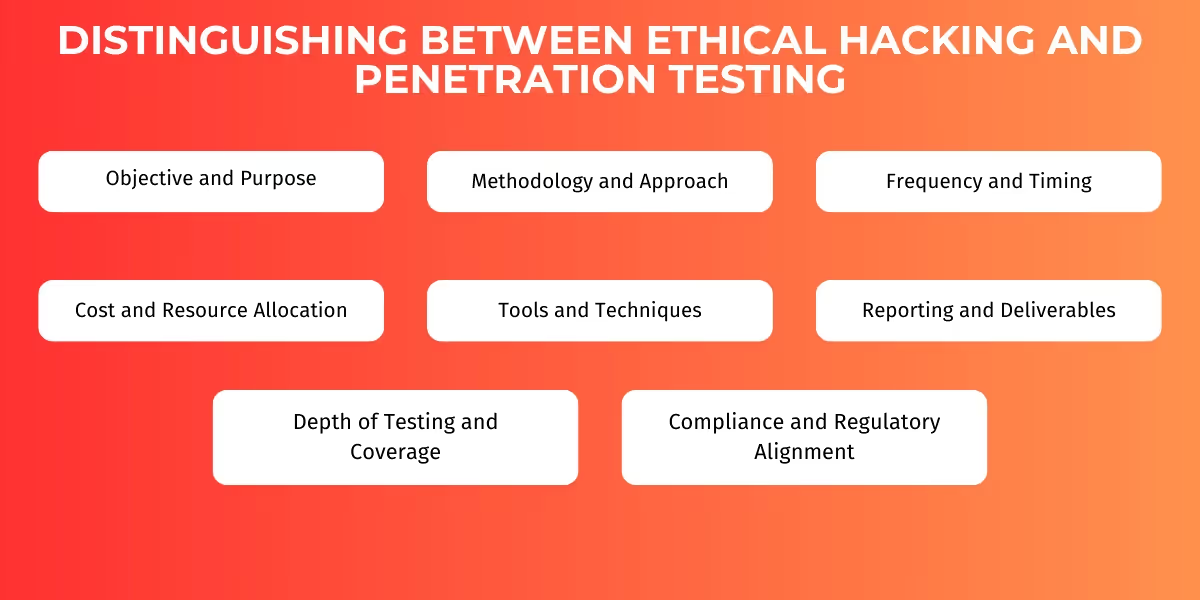
Objective and Purpose
- Pentesting Objectives: Pentests are typically focused on uncovering vulnerabilities within a defined scope, like a specific application or network segment. They are conducted to identify weaknesses, validate security controls, and ensure compliance. The end goal is to produce a report that includes detailed findings and prioritized recommendations.
- Ethical Hacking Objectives: Ethical hacking aims to mimic the mindset and techniques of malicious attackers to discover a wide range of vulnerabilities. Ethical hackers seek to continuously improve the security posture by thinking like adversaries, aiming to preemptively secure against unknown attack vectors and emerging threats.
Methodology and Approach
- Pentesting Methodology: Pentesting is methodical, following industry standards like the OWASP Top 10, SANS Top 25, WSTG, ASVS, and NIST. Tests are scoped, time-boxed, and designed to identify and exploit specific vulnerabilities within a given target area. Pentesting generally follows a set of pre-determined phases: reconnaissance, scanning, exploitation, and reporting.
- Ethical Hacking Methodology: Ethical hacking is less structured and more adaptive. Ethical hackers may continuously evaluate security controls, explore various attack vectors, and simulate multiple types of attacks.
Frequency and Timing
- Pentesting Schedule: Pentesting is usually conducted at scheduled intervals, such as annually, quarterly, or after significant changes (e.g., deploying a new application or system). It is a point-in-time evaluation of security posture and provides a snapshot of vulnerabilities within that timeframe. Pentesting should be conducted at least annually.
- Ethical Hacking Schedule: Ethical hacking can be ongoing or performed as needed, especially in agile environments where security is built into the development and operational processes. Ethical hackers may continuously monitor, probe, and test the environment, adapting to new threats and changes as they occur.
Depth of Testing and Coverage
- Pentesting Coverage: Pentests are focused and in-depth within a focused scope. The narrow focus allows for deep exploration of specific systems. For example, a pentest might target a single application or network segment without examining other systems or the broader security posture.
- Ethical Hacking Coverage: Ethical hacking is broad, covering multiple facets of the organization’s security, including network, application, physical security, employee awareness, and more.
Tools and Techniques
- Pentesting Tools: Pentesters use specific tools for tasks like scanning, vulnerability assessment, and exploitation (e.g., Nessus, Metasploit, and Burp Suite). The toolset is generally tailored to the particular systems and scope defined for the pentest.
- Ethical Hacking Tools: Ethical hackers have access to a broad range of tools, combining pentesting tools with other resources for reconnaissance, social engineering, password cracking, and phishing simulations.
Reporting and Deliverables
- Pentesting Reports: Pentesting culminates in a formal report detailing vulnerabilities, exploits, and prioritized remediation recommendations. Reports are structured to meet compliance requirements and often serve as documentation for audits.
- Ethical Hacking Insights: Ethical hacking may or may not produce a single formal report, depending on its ongoing nature. Instead, ethical hackers provide continuous feedback, alerts, and insights into potential weaknesses, enabling iterative security improvements. In some cases, ethical hacking engagements provide summary reports on trends, findings, and recommendations.
Compliance and Regulatory Alignment
- Pentesting for Compliance: Pentesting is often a regulatory requirement for standards such as PCI-DSS, HIPAA, SOC 2, and ISO 27001. These standards mandate regular testing to validate that security controls are in place and effective, assuring auditors and regulatory bodies. It helps organizations go beyond basic compliance to build a resilient security posture that meets and often exceeds regulatory standards.
- Ethical Hacking for Proactive Security: While ethical hacking is not always required by compliance standards, it complements regulatory requirements by providing proactive security insights and adapting to new threats.
Cost and Resource Allocation
- Pentesting Costs: Pentesting is typically a fixed-cost engagement, given its defined scope and duration. Costs are often budgeted for specific assessments, such as annual, biannual, or quarterly tests or post-deployment evaluations.
- Ethical Hacking Costs: Ethical hacking can vary widely in cost depending on whether it’s conducted in-house or outsourced and on its ongoing nature. While more resource-intensive, continuous assessment can be more cost-effective in the long term by identifying vulnerabilities before they lead to costly breaches.
Ethical Hacking vs. Penetration Testing: Which is right for your business?
Deciding between ethical hacking vs penetration testing for your company often comes down to scope, intent, and structure. Ethical hacking may involve exploratory testing across broader systems, while penetration testing follows a defined methodology focused on measurable outcomes.
Pen testing vs ethical hacking differs in how success is measured: penetration testing validates defenses against specific attack scenarios, while ethical hacking can be more open-ended. Businesses with compliance needs often favor penetration testing for its repeatability and reporting rigor.
Organizations facing evolving threats may benefit from combining both approaches. Understanding the differences between penetration testing vs ethical hacking helps leaders choose the right engagement based on risk tolerance, regulatory pressure, and maturity. The best choice depends on whether the goal is discovery, validation, or assurance across critical assets.
How do ethical hackers and penetration testers work together?
Ethical hacking and penetration testing complement each other in mature programs by balancing creativity with repeatability. Certified ethical hackers may explore unconventional attack paths, validate assumptions, and look for edge cases that automated checks miss. Meanwhile, penetration testers apply structured testing so results are consistent, scoped, and defensible.
The ethical hackers’ responsibilities often include exploring novel techniques and emerging patterns, while penetration testers repeatedly validate results across environments and document exactly how controls fail. Together, they help organizations identify security weaknesses and exploit vulnerabilities responsibly without disrupting production.
Collaboration also improves triage by separating noise from true security vulnerabilities and mapping findings to business impact. When aligned, ethical hacking and penetration efforts improve communication between engineering and security, increase testing coverage, and strengthen decision-making without sacrificing control or auditability.
Future Trends in Ethical Hacking: AI
AI is transforming ethical hacking by automating tasks like vulnerability scanning, threat detection, and anomaly analysis, making it faster and more efficient. AI-powered tools can analyze vast amounts of data, identify patterns, and simulate attacks with greater accuracy. The future of ethical hacking looks promising, with AI enabling more proactive, real-time security measures. However, AI also has limitations, such as being dependent on quality data, potentially missing complex, nuanced threats, and facing challenges in adapting to evolving attack methods, meaning human expertise is still essential for comprehensive security.
Check out the AI Security landscape and common vulnerabilities to learn how hackers are weaponizing AI.
At Software Secured, we aim to assist organizations in facing such issues. We provide top-notch application security designed specifically for a software company in a growth stage. Our expert ethical hackers are one step ahead in progress and ensure that your applications are not vulnerable to the most recent threats. We are skilled in both ethical hacking and pentesting techniques and stay updated on the latest security trends.
If you've worked through the distinctions in this post and have concluded that a structured, scoped penetration test is what your organization needs, see how Software Secured approaches web application penetration testing including how engagements are scoped, what rules of engagement look like in practice, and what the deliverable includes beyond a list of CVEs.
Frequently Asked Questions:
Are penetration testing and ethical hacking the same thing?
Penetration testing and ethical hacking are related but not identical. Penetration testing follows a defined scope and methodology, while ethical hacking may be broader and more exploratory. Both aim to uncover security vulnerabilities, but penetration testing emphasizes validation, reporting, and repeatability.
Who performs penetration testing?
Penetration testing is performed by trained penetration testers with expertise in various applications, networks, and infrastructure, and in any environment that needs to be tested. These professionals understand attacker techniques and defensive controls, allowing them to safely simulate attacks and provide actionable remediation guidance tailored to business risk.
Who performs ethical hacking?
Ethical hacking is performed by certified ethical hackers who use attacker techniques with explicit authorization to test defenses. Their work focuses on creatively uncovering security vulnerabilities, validating exploit paths, and documenting risk. They operate within the organization's defined legal and ethical boundaries.
Do penetration testers use the same tools as ethical hackers?
Penetration testers and ethical hackers both will often use similar tools, but how they apply them differs. Penetration testers prioritize controlled execution and documentation, while ethical hackers may experiment more freely. Both approaches help expose security risks when used responsibly.
Which approach is better for small businesses?
For small businesses, penetration testing is often the better starting point because it provides a clear scope, predictable cost, and actionable results. Ethical hacking can add value later as programs mature and organizations seek deeper insight into emerging attack techniques.
Ready to get in touch? Get started by booking a consultation now.
About the author