
Black Box vs White Box Penetration Testing: Key Differences Explained
Understand the core differences between black box, white box, and grey box penetration testing to choose the best security strategy for your organization.
Black box, white box, and grey box penetration testing differ in one fundamental way: the amount of internal knowledge the tester starts with.
Black box testers receive nothing. No source code, credentials, or architecture diagrams.
White-box testers have full access to internal systems and documentation.
Grey box sits between the two, giving testers partial access, such as login credentials, to test authenticated workflows from an attacker's perspective.
This guide breaks down each approach, explains where the grey box fits, and helps you choose the right technique for your environment and compliance requirements.
Black Box Pentesting
What Is Black Box Penetration Testing?
During black box pentesting, testers approach the target exactly as an external attacker would. They use public information and active reconnaissance, with no privileged starting knowledge. NIST SP 800-115 describes this type of testing as the closest simulation of an opportunistic external threat.
The Black Box Testing Process
Since testers start blind, reconnaissance takes significantly longer than in other models. Testers surface subdomains via certificate transparency logs, scan all TCP ports, probe public-facing APIs for data leakage, and map the attack surface from scratch before a single exploit attempt.
The test doesn't assume what's exposed. That makes black box testing most valuable as a perimeter assessment, where you want to know what a motivated attacker could discover and exploit without any inside help.
Where Black Box Falls Short
Black-box pen testing cannot uncover vulnerabilities that sit behind authentication; business logic errors, authorization failures, and role-based access issues all require a tester who can log in and navigate. If your most critical risk lies within the application rather than at its perimeter, black box testing will yield an incomplete picture.
White Box Pentesting
What Is White Box Penetration Testing?
White-box penetration testing (also called crystal-box, glass-box, or transparent-box testing) provides testers with full visibility before the engagement begins: source code, network diagrams, architecture documentation, and credentials. The goal shifts from discovery to depth.
What Testers Do With Full Internal Visibility
With source code in hand, testers combine static analysis with dynamic testing. They trace data flows, identify insecure configurations, and probe logic that depends on internal state, uncovering insecure cryptography, broken authorization, hardcoded credentials, and race conditions that external testing simply cannot reach. Control-flow analysis, data-flow tracing, and manual review of authorization logic are all standard techniques.
Access to code also changes where testers spend their time. Rather than building an attack surface map from scratch, they can go directly to high-risk areas (authentication modules, privilege checks, data handling functions) and test in depth from the first day of the engagement.
White Box vs Black Box Penetration Testing: Key Differences
White-box testing is best for pre-release security reviews, SDL-aligned compliance assessments, healthcare platforms, financial applications, and multi-tenant SaaS products where authorization logic is the primary attack surface. It requires testers with programming knowledge and often involves developers explaining design decisions, so scoping is more involved.
The trade-off is that white box testing doesn't simulate how an attacker without insider access would actually approach your environment. Findings may include vulnerabilities that are theoretically present in the code but difficult to exploit from real external positions.
Both approaches have blind spots. The right choice depends on whether realism or depth matters more and which vulnerability classes pose the greatest risk.
The most important distinction isn't cost or time but vulnerability coverage. Black box testing can miss everything behind a login. White-box testing can uncover deep code defects that may never be reachable from the outside. Choosing between them means deciding which risk matters more for a given engagement.
Where Grey Box Penetration Testing Fits
Grey box testing gives testers partial knowledge, typically login credentials for one or more user roles, and sometimes basic architecture context, without full code access. They test authenticated workflows while maintaining an external attacker's perspective.
This is the standard model for SaaS and web application engagement s, because it reflects how real attackers operate after gaining initial access: with a foothold, but not full insider visibility. It answers the practical question most SaaS security teams actually need answered: what can someone with legitimate access do that they shouldn't be able to?
Grey box is effective for finding IDOR vulnerabilities, broken access controls, and privilege escalation paths, all of which require authentication to test. It won't catch deep code-level flaws without source access, and it may not surface every externally exploitable path a fully blind test would follow. But for teams doing ongoing testing between releases, it offers a fast-to-scope, realistic, and authenticated-focused option.
How to Choose the Right Penetration Testing Approach
Security Maturity
Teams early in their security program often benefit most from black-box or grey-box testing. They need to know what's exposed before optimizing depth. Mature teams with prior pentest experience and secure development practices typically gain more from white box testing, since they may have already resolved surface-level issues.
Application Complexity
Complex applications with multi-tenant data handling, detailed authorization models, or business-critical backend logic generally warrant white-box or grey-box testing. Simpler external-facing systems are often well-served by a black box.
Compliance Requirements
No major framework mandates a specific testing model. PCI DSS v4.0 Requirement 11.4 requires testing from both internal and external perspectives and explicitly allows any combination of black-, white-, and grey box approaches. SOC 2 Type II auditors expect evidence that testing reflects real attack vectors. HIPAA requires a method appropriate to PHI risk. ISO 27001 aligns model selection with the organization's risk assessment.
In practice, most mature organizations blend approaches. Black box before an external audit to validate internet-facing systems, white box before a major release to catch logic errors in new code, and grey box for ongoing quarterly testing of authenticated application workflows.
Testing Frequency
Organizations handling payment data or personal health information often test more frequently than once a year, especially after major changes or new feature releases. Major infrastructure changes, new integrations, and updated authorization flows can all introduce gaps that shouldn't be left to an annual cycle.
Common Mistakes to Avoid When Scoping a Penetration Test
Scoping errors are one of the most common reasons a pentest fails to deliver useful results.
Choosing by Price
Black box testing may seem more affordable at first, but if the main risk lies in authenticated workflows or application logic, it won't provide sufficient depth. Findings may satisfy a compliance checkbox while missing the vulnerabilities that could cause real damage.
Restricting Access
Limiting credentials, excluding systems, or drawing boundaries around internal politics produces narrower findings. Untested vulnerabilities remain in the environment until something else surfaces them.
Ignoring Business Logic
Automated scanners struggle to identify business logic vulnerabilities because they lack application context. Logic flaws require a tester who understands how the application should behave and can probe for ways to make it behave incorrectly.
Skipping Retesting
A fixed vulnerability that isn't verified is only assumed closed. PCI DSS v4.0 requires retesting after remediation to confirm vulnerabilities are resolved, and most frameworks treat verification as a baseline expectation.
Treating Test Type as Fixed
Many organizations use the same testing model every year without asking whether it still fits. A SaaS platform that used a black box two years ago may now have a wider API layer, new integrations, and a more complex authenticated surface. Revisit the model before each engagement.
How Manual Penetration Testing Improves Results
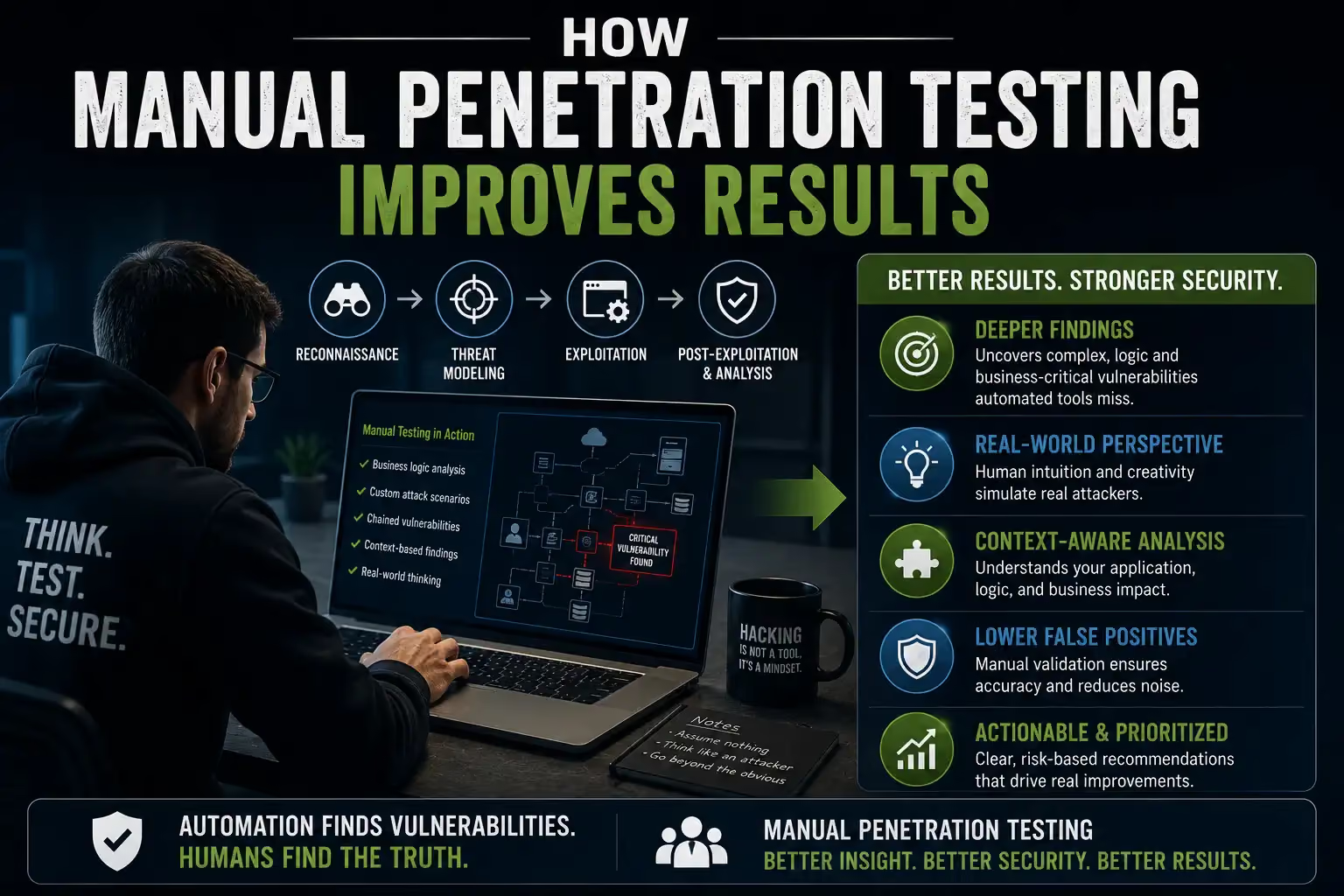
The testing model determines starting conditions. Whether the engagement is manual or automated determines how deep the findings go.
Manual Validation
Automated scanners identify known vulnerability patterns, but they cannot understand context. They may not recognize that two medium-severity findings can chain into a critical exploit path. Manual pen testing adds judgment, as a skilled tester assesses whether a finding is exploitable in the actual environment.
Chained Exploits
The most serious vulnerabilities in modern applications are often chains of lower-severity findings. An XSS on a subdomain, an improperly scoped session cookie, and an accessible internal API endpoint may each seem moderate on their own. Together, they can lead to account takeover. Manual testing surfaces these chains by asking what each exploit unlocks next.
Remediation Guidance
A quality manual pentest should include developer-facing remediation guidance for every finding. Retesting is built into every engagement to confirm fixes work. That is what separates a report that satisfies an auditor from one that improves the environment. For teams evaluating penetration testing services , this post-finding support is where a capable vendor shows real value. If you're ready to choose a provider, see how leading vendors compare in this breakdown of the top 10 penetration testing vendors .
FAQs About Black Box vs White Box Penetration Testing
Is black-box or white-box penetration testing better?
Neither is universally better. A black box realistically simulates an external attacker but can miss logic flaws and vulnerabilities that require authenticated access. White-box testing provides deeper code coverage but reflects an insider’s perspective rather than an external threat's. The right choice between black-box and white-box penetration testing depends on security maturity, test goals, and the frameworks involved.
What is grey box penetration testing?
A grey box provides testers with partial knowledge, such as user credentials or limited architectural context, so they can test authenticated workflows while maintaining an external attacker’s perspective. It is a standard setup for web application and API testing, where the most important risks often reside behind the login.
When should a company use white box testing?
White box testing is most valuable for complex applications nearing release, systems with sensitive data flows, and organizations that have already addressed surface-level issues through prior testing. It is also useful for SDL assessments that require source code review.
Does compliance require a specific type of penetration test?
Requirements vary by framework and should be mapped to your risk profile and data in scope. Whichever penetration testing companies you evaluate, the model they recommend should align with the relevant framework and your actual business risk, not with whichever option is easiest to scope or sell.
Ready to get in touch? Get started by booking a consultation now.
About the author

Kaycie Waldman
Demand Generation Manager
Kaycie Waldman works closely with SaaS, cloud, and technology organizations on security, risk, and compliance initiatives that support growth and enterprise readiness. Her work spans strategic content, go-to-market initiatives, and customer trust programs designed to support scale, compliance, and enterprise sales.





.avif)